Toyota's luxury vehicle division, launched in 1989 with the LS 400 sedan to prove a Japanese manufacturer could match German luxury refinement on its own terms.
Lexus exists because of a direct, deliberate corporate decision: in 1983, Toyota chairman Eiji Toyoda asked whether the company could build the best car in the world, launching a secret programme (initially known internally as the F1 project, "flagship one," unrelated to the racing series) with no fixed budget and one instruction: benchmark against Mercedes-Benz and BMW, and beat them on refinement, not just value. Six years and roughly a billion dollars of development later. The result was the original LS 400, a car whose near-silent V8 and obsessive attention to noise, vibration, and harshness stunned the established luxury establishment on its 1989 launch.
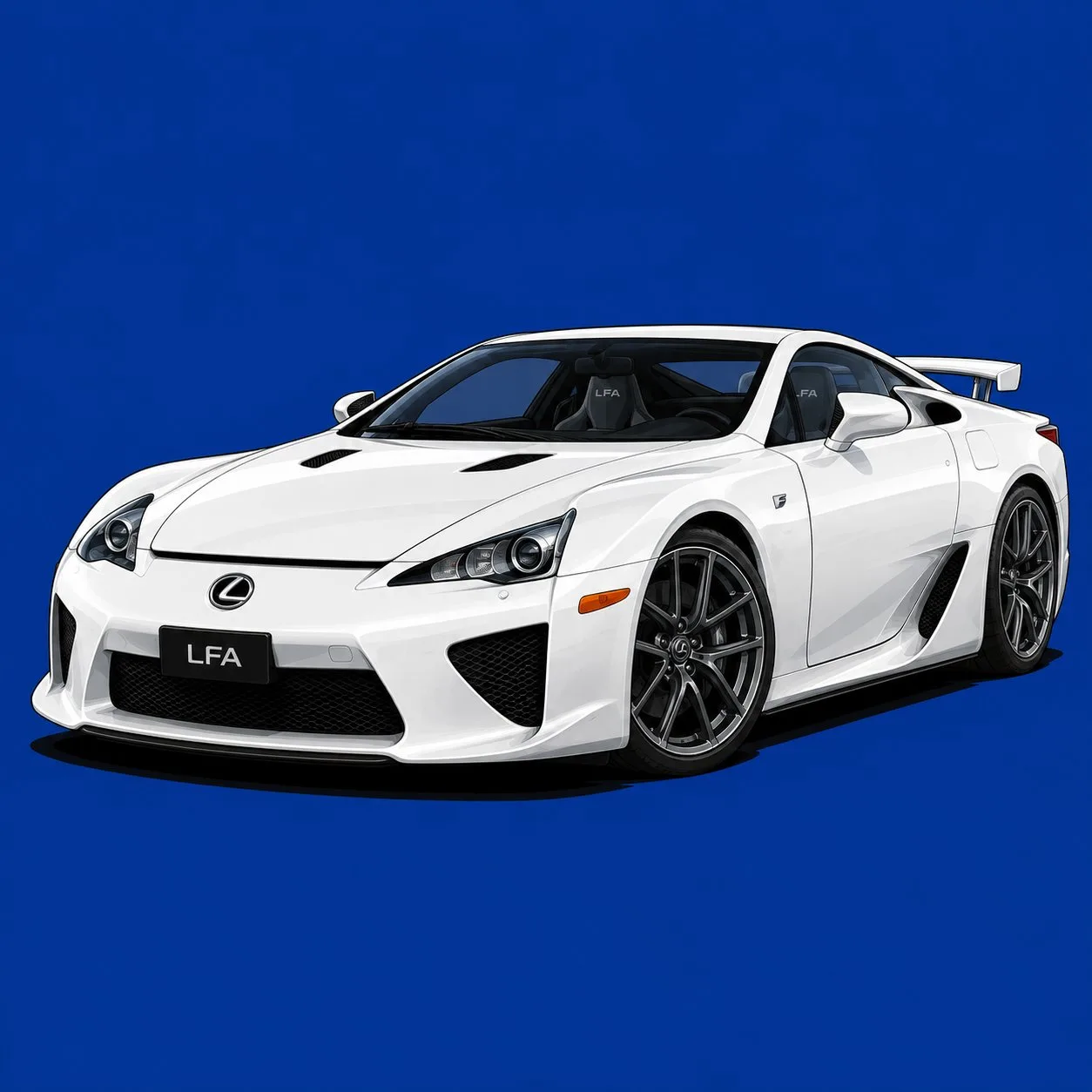
Where the brand once relied entirely on quiet competence. Its more recent decades have added a genuine performance and design ambition to that reputation, most dramatically with the naturally aspirated V10 LFA supercar, a low-volume, hand-built halo project that had almost nothing in common commercially with the sedans that built the brand, but everything to do with proving the same obsessive engineering culture could be pointed at an entirely different kind of car.
↓ Read deeper↑ Less
The F1 project's chief engineer, Ichiro Suzuki, assembled a team that ultimately tested more than 450 prototype engines and logged well over two million kilometres of durability testing before the LS 400 reached production, an effort disproportionate to any normal product-development budget, justified internally purely by the goal of establishing instant credibility in a segment where the Japanese industry had none. The car's US launch in 1989, undercutting Mercedes-Benz and BMW's equivalent models substantially on price while matching or exceeding them on refinement, is widely credited with permanently shifting how the global luxury car market judged Japanese manufacturing quality.
Lexus was launched as a US-market brand first, deliberately kept separate from the Toyota name so as not to alarm either existing Toyota's value-brand positioning or the segment's traditional customers with an unfamiliar luxury nameplate; the brand did not sell cars under the Lexus name in Japan itself until 2005, selling equivalent models domestically under Toyota's own upmarket dealership channels until then.
The LFA (2010), by contrast, inverted the brand's usual priorities almost entirely: rather than refinement through isolation, its howling naturally aspirated V10 (developed with input from Yamaha, tuned specifically for exhaust note as much as for output) and a carbon-fibre monocoque built on dedicated looms were engineered to make as much emotional noise as the LS 400 had been engineered to make none, a 500-unit halo car that, commercially, existed purely to prove Lexus's engineering department could do more than isolate a cabin from the road.
Origins
How did it begin?
Lexus's founding moment is unusually well documented, because it began with a single, specific instruction rather than a gradual market drift upmarket. In 1983, Toyota chairman Eiji Toyoda posed a direct question to his engineering staff: could Toyota build the best car in the world? The answer became a secret internal programme, code-named "F1" (for "flagship one," unconnected to Formula One racing), with an unusually open-ended budget and a singular benchmark, matching or beating Mercedes-Benz and BMW's flagship sedans on refinement.
The programme's six years of development, led by chief engineer Ichiro Suzuki, culminated in the original LS 400, launched in the United States in 1989 under the newly created Lexus brand name, deliberately separate from Toyota's own, more value-oriented identity.
↓ Read deeper↑ Less
The scale of the F1 project's engineering effort became one of the more widely cited case studies in automotive development history: more than 450 prototype engines built and tested, and well over two million kilometres logged in durability and refinement testing, aimed specifically at eliminating noise, vibration, and harshness to a degree the established luxury manufacturers had not attempted.
Toyota's decision to launch the resulting car under an entirely new brand name, rather than as a flagship Toyota, reflected a clear-eyed read of Western luxury-car buyers' assumptions: a "Toyota" badge, however excellent the underlying engineering, carried value-market associations the company judged incompatible with a genuine luxury positioning, particularly in the crucial US market where Lexus launched first.
Lexus did not become available under its own name in Japan until 2005. For the brand's first sixteen years, equivalent models were sold domestically through Toyota's own separate upmarket dealership channels (Toyota Store, Toyopet), a reflection of how differently the company judged its home and export markets would receive an entirely new luxury identity.
Design Philosophy
What does it stand for, visually?
Lexus's earliest design language (the original LS 400 and its contemporaries) was deliberately understated, smooth, conservative surfacing intended to signal quiet competence and engineering refinement rather than visual drama, a strategy suited to a brand-new luxury marque trying to earn credibility through substance rather than styling flair.
That approach shifted decisively from the 2010s onward with the introduction of the "spindle grille", a large, distinctively shaped front grille design intended to give Lexus a genuinely recognizable visual signature after two decades of comparatively anonymous styling, a change that has been polarizing among both critics and longtime owners.
↓ Read deeper↑ Less
The original LS 400's design (1989) was engineered as much for aerodynamic and noise-reduction performance as for visual appeal. Its smooth surfacing directly served the car's engineering brief of minimizing wind noise, part of the broader "flagship one" project's obsessive focus on refinement over styling drama.
The LFA's design (2010) marked a deliberate departure from Lexus's usual restraint, a low, aggressive supercar silhouette developed specifically to signal the car's radically different engineering priorities (naturally aspirated V10 performance) from the brand's typical sedan lineup.
The spindle grille's introduction (first on concept cars around 2011, then production models) reflected Lexus's broader strategic shift toward a more emotionally distinctive design identity, intended to help the brand compete more directly against increasingly dynamic-looking rivals from BMW and Mercedes-Benz rather than relying purely on its reputation for quiet refinement.
Engineering Philosophy
How does it engineer?
Lexus's engineering identity was established through an unusually rigorous, almost obsessive validation process: the original LS 400 programme tested more than 450 prototype engines and logged well over two million kilometres of durability testing, all aimed specifically at eliminating noise, vibration, and harshness to a degree the established German luxury manufacturers had not attempted at the time.
That same benchmark-driven, exhaustive-testing engineering culture was later redirected toward an entirely different goal with the LFA (2010), rather than eliminating noise and vibration, the LFA's development focused on engineering a specific, deliberately crafted engine sound (developed with input from Yamaha) alongside genuine track-level performance.
↓ Read deeper↑ Less
The LS 400's engineering team, led by chief engineer Ichiro Suzuki, reportedly physically disassembled and analyzed competitor Mercedes-Benz and BMW flagship sedans component by component to identify precisely where Toyota's existing manufacturing capability fell short of luxury-segment expectations, then directed engineering resources specifically at closing those gaps, an unusually systematic, almost forensic approach to a luxury car's development brief.
The LFA's carbon-fibre monocoque construction, built on dedicated looms specifically developed for the project, represented a genuine engineering departure from Lexus's typical steel-and-aluminum construction, reflecting the scale of investment Toyota was willing to commit to a low-volume (500-unit) halo project with limited direct commercial return.
Lexus's hybrid powertrain engineering (inherited from and developed alongside parent company Toyota's own hybrid technology leadership) has applied the same benchmark-driven refinement culture to luxury-segment hybrid and, more recently, electric vehicles.
Notable Works
What did it create?
The LS 400's 1989 launch stands as Lexus's single most consequential achievement, undercutting Mercedes-Benz and BMW's equivalent flagship sedans substantially on price while matching or exceeding them on refinement, an outcome widely credited with permanently shifting international perception of Japanese luxury-manufacturing capability.
The LFA (2010) represents a very different but equally significant achievement: a 500-unit, hand-built halo supercar with a specifically engineered naturally aspirated V10 exhaust note, developed at substantial cost with limited direct commercial return, existing primarily to prove Lexus's engineering department could excel at raw performance and emotion, not just refinement.
↓ Read deeper↑ Less
The LS 400's development cost and testing scale (reportedly approaching a billion dollars in 1980s currency) reflected Toyota's willingness to invest disproportionately in establishing instant credibility for an entirely new luxury brand, a bet that paid off given the car's critical reception and its lasting effect on how Japanese manufacturing quality was perceived internationally.
The LFA's Yamaha-developed exhaust note was engineered with the same rigor Lexus typically applies to noise elimination, in this case redirected toward crafting a specific, deliberately pleasing sound signature, an unusual and genuinely novel engineering brief for a production car.
The LFA's limited 500-unit production run and multi-year waiting list (with Lexus reportedly requiring buyers to submit applications rather than simply placing an order) reflected the car's positioning as a genuine halo statement rather than a volume product, a rare approach for a brand otherwise built around accessible luxury.
Key People
Who shaped it?
Lexus's key founding figures reflect its origin as an internal corporate challenge rather than an independent startup: a chairman who posed the question, and a chief engineer who spent six years answering it with an almost unprecedented development budget and testing regime.
Ichiro Suzuki in particular is remembered within Toyota's engineering culture as the figure who proved the company's manufacturing discipline could be redirected toward outright luxury refinement, not just reliability and value, a distinction that mattered enormously to how the LS 400 was received internationally.
↓ Read deeper↑ Less
Eiji Toyoda, a cousin of Toyota's founding Toyoda family and the company's chairman through the 1980s and into the 1990s, is credited with posing the original challenge that became the F1/Lexus project, reportedly frustrated that Toyota's reputation, however commercially successful, still carried none of the prestige of the German luxury marques the company's own executives drove.
Ichiro Suzuki, appointed chief engineer of the F1 project, structured the six-year development programme around an unusually rigorous benchmarking process, physically disassembling and analysing competitor Mercedes-Benz and BMW flagship models component by component to identify where Toyota's existing manufacturing capability fell short, then directing engineering resources specifically at closing those gaps.
The success of the LS 400 under Suzuki's leadership established Lexus's engineering department's credibility within Toyota for later, more ambitious departures from pure luxury refinement, most notably the LFA supercar programme two decades later, which drew on the same culture of open-ended, benchmark-driven development but pointed it at outright performance and driving emotion instead.
Lexus's motorsport presence has historically been more modest than parent company Toyota's broader rallying and Le Mans prototype programmes, concentrated instead on GT and touring-car-style racing (the IS F CCS-R, RC F GT3) and a distinctive Nürburgring 24-hour endurance racing programme used specifically to validate the LFA's development.
The LFA's Nürburgring racing programme, running privately-entered but factory-supported development cars for several years before the road car's 2010 launch, represented an unusually direct in-competition validation process for a road car, rather than a separate post-launch racing effort.
rivals-comparisons
What did it compete against?
Editorial inference
Lexus's entire founding brief was framed as a direct rivalry with Mercedes-Benz's and BMW's flagship sedans, the LS 400's development explicitly benchmarked against the S-Class and 7 Series, aiming to match or exceed their refinement while undercutting their price substantially.
The LFA, by contrast, was more frequently compared in the press against Porsche's Carrera GT and various Ferrari models as a naturally aspirated, engineering-driven halo supercar competing on emotional and performance terms rather than value.
pop-culture-sightings
What does it mean in culture?
Editorial inference
The LFA's deliberately engineered exhaust note became something of a cultural artifact in its own right within car-enthusiast media, frequently featured in dedicated engine-sound videos and reviews specifically celebrating its acoustic engineering, an unusual form of pop-culture attention focused on sound rather than visual spectacle.
The original LS 400's cultural significance was more journalistic than cinematic, its 1989 launch generated extensive automotive press coverage specifically framed around the "can a Japanese car really compete with Mercedes and BMW" question, itself becoming a notable moment in how the motoring press covered Japanese manufacturing credibility.
model-catalogue
What are its defining models?
Editorial inference
As a brand founded in 1989, Lexus's catalogue is genuinely younger than most of its German rivals', but has still produced a distinct range of significant nameplates, the founding LS flagship, the sportier IS and SC lines aimed at younger buyers, the RX (widely credited with helping establish the luxury-SUV segment commercially), and the standalone LFA halo supercar.
The list below favors genuinely distinct, historically significant nameplates and generations over every individual regional trim.
timeline-evolution
How did it evolve?
Editorial inference
Lexus's timeline is unusually well-documented from its very inception: a specific 1983 internal challenge from Toyota chairman Eiji Toyoda, a secret multi-year development programme, and a carefully staged 1989 international launch, followed by a gradual broadening of the model range through the 1990s–2000s and a deliberate 2010s design-language shift to build a more distinctive visual identity.
The brand's delayed domestic Japanese launch (2005, sixteen years after its US debut) reflects a distinctly different strategic calculation for Toyota's home market versus its export markets.
myths-misconceptions
What do people get wrong about it?
Editorial inference
Claim: Lexus cars are just rebadged Toyotas with a nicer interior. Truth: while Lexus and Toyota do share platforms and components across parts of the lineup (a common and economically necessary practice across the luxury-auto industry broadly), the brand's flagship and halo models, the original LS 400 and especially the LFA, involved dedicated, from-scratch engineering programmes with no direct Toyota-badged equivalent, representing genuine standalone engineering investment rather than simple badge engineering. attributed
Claim: Lexus has always been sold in Japan under its own name, just like everywhere else. Truth: Lexus was not sold under its own brand name in Japan until 2005. For the brand's first sixteen years, equivalent models were sold domestically through Toyota's own separate dealership channels rather than as a distinct Lexus-branded product. verified
legacy
What did it leave behind?
Editorial inference
Lexus's most consequential legacy is the LS 400's demonstrated proof that Japanese manufacturing could match or exceed the world's most established luxury-car makers on their own terms, a single, meticulously engineered product launch that shifted international perception of Japanese automotive quality more broadly, not just for Lexus itself.
The LFA's legacy, more narrowly but no less significantly, is proof that the same obsessive engineering culture responsible for the LS 400's refinement could be redirected toward genuine emotional, performance-driven engineering when the brand chose to pursue it.
Sources & Confidence
Claims in this profile draw on categories of source material appropriate to their confidence level: company-published corporate history for founding dates and the "F1" project; period automotive journalism (comparative road tests against the S-Class and 7 Series) for the LS 400's reception; and established automotive-history texts for the LFA's development, including its Nürburgring testing programme.
Questions readers ask
When was Lexus founded?
Lexus was launched in 1989 as Toyota's luxury division, the result of a secret development programme (internally called the "F1 project") that began in 1983.
Is Lexus just a rebadged Toyota?
Not entirely. While some platform-sharing exists across parts of the lineup, flagship and halo models like the original LS 400 and the LFA involved genuinely dedicated, standalone engineering programmes with no direct Toyota-badged equivalent.
What is the Lexus LFA?
A 500-unit, hand-built halo supercar (2010) featuring a naturally aspirated V10 engine with a specifically engineered exhaust note developed with input from Yamaha.
When did Lexus start selling cars in Japan under its own name?
2005, sixteen years after its US launch; before that, equivalent models were sold domestically through Toyota's own separate dealership channels.
Who is Lexus's parent company?
Toyota Motor Corporation.
Lexus: Japanese Luxury Manufacturer | Engine Sphere