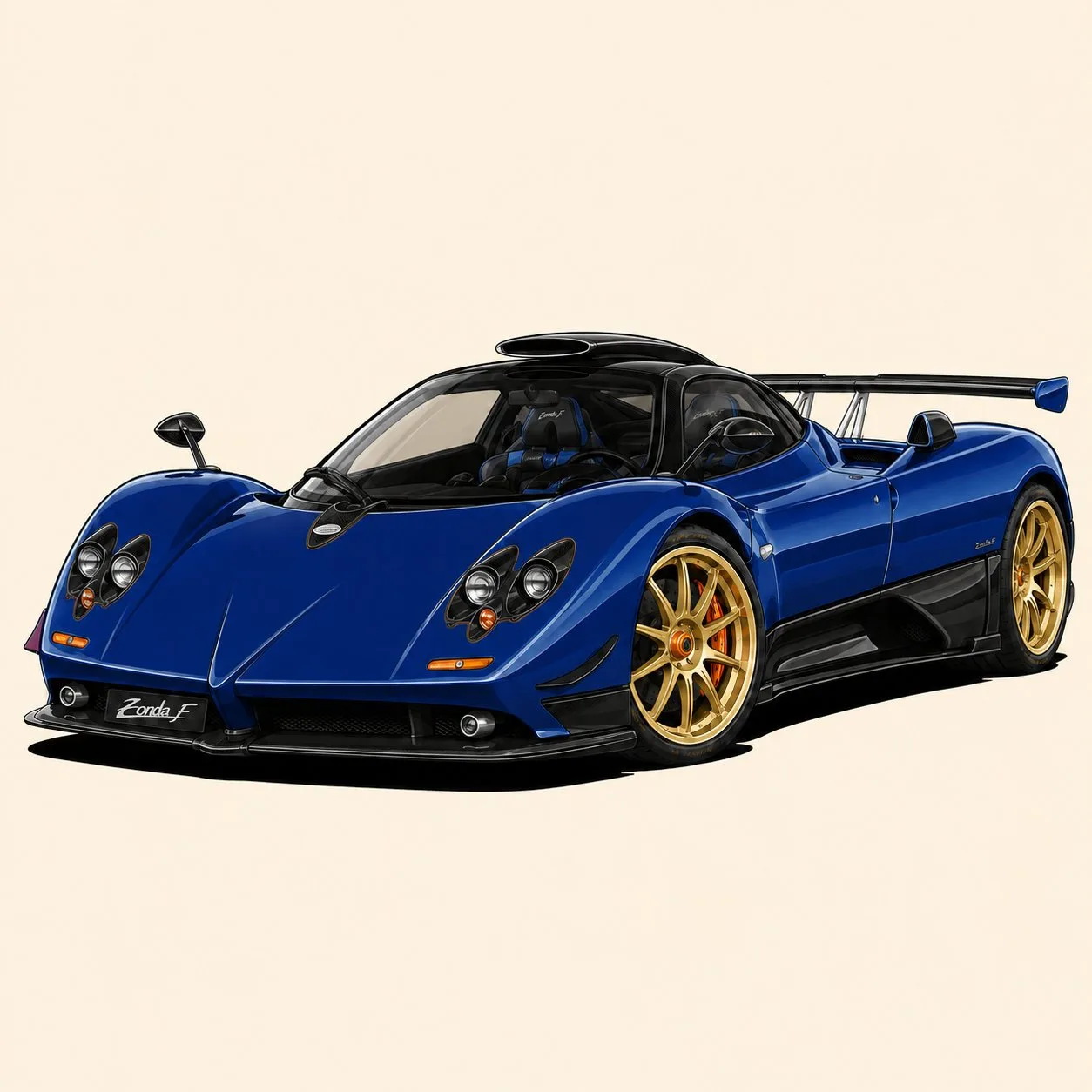
Small, independent Italian hypercar manufacturer near Modena, founded in 1992 by Horacio Pagani, distinguished by hand-built carbon-fibre construction.
Pagani occupies a category of one: a manufacturer producing only a handful of cars per year, each one closer to a hand-finished sculpture than an assembly-line product, built by a founder who trained as a composite-materials specialist at Lamborghini before deciding to start again from first principles under his own name. Where most hypercar makers hide their mechanical complexity beneath smooth bodywork, Pagani's signature is the opposite instinct: exposed carbon-fibre weave, milled aluminium linkages, and gear levers machined like jewellery, all deliberately visible as if the engineering itself were the ornament.
The company's entire existence rests on the patient, decade-long gestation of a single idea, the Zonda, developed quietly through the 1990s with no guarantee it would ever reach production, before it finally launched in 1999 and established, almost single-handedly, that a genuinely new hypercar marque could still be founded from nothing in an industry usually assumed to be closed to newcomers.
↓ Read deeper↑ Less
Horacio Pagani emigrated from Argentina to Italy in 1982 specifically to work near his idol Juan Manuel Fangio's old circles and closer to Lamborghini, where he was hired and became the company's leading composite-materials specialist through the 1980s, working on the Countach Evoluzione concept, one of the first Lamborghinis to experiment seriously with carbon-fibre construction. Frustrated that Lamborghini's then-ownership (Chrysler at the time) would not invest further in the carbon-fibre autoclave technology he wanted to pursue, Pagani left to found his own composite-engineering consultancy, Modena Design, in 1991, before establishing Pagani Automobili proper in 1992.
The Zonda's eight-year development, largely self-funded and self-directed, was possible partly because Pagani's consultancy business (supplying carbon-fibre components and expertise to other manufacturers and even to Formula One and aerospace clients) generated the capital and the credibility a hypercar project of this ambition would otherwise have required from an established backer. The result, launched in 1999 and powered by a Mercedes-AMG V12, established the template, extreme, visible carbon-fibre construction, an ever-evolving list of special editions rather than fixed model years, and a level of interior detailing (milled aluminium switchgear, exposed gear linkages) that had no real precedent in the segment.
Pagani has remained deliberately, defiantly independent and family-run through its subsequent Huayra generation and beyond, a rare case in the modern hypercar landscape of a marque founded from nothing within living memory, run entirely on its own terms, without ever selling a controlling stake to a larger automotive group.
Origins
How did it begin?
Horacio Pagani's path to founding his own manufacturer began at a rival: he emigrated from Argentina to Italy in 1982, drawn by his admiration for compatriot racing legend Juan Manuel Fangio and by his ambition to work in Italian sports car engineering, and was hired by Lamborghini, where through the 1980s he became the company's foremost specialist in carbon-fibre composite construction.
Frustrated that Lamborghini's ownership at the time would not fund the advanced carbon-fibre autoclave technology he believed the company needed, Pagani left to found his own composites consultancy, Modena Design, in 1991, and Pagani Automobili itself the following year, beginning an eight-year, largely self-funded development process that would eventually produce the Zonda.
↓ Read deeper↑ Less
Pagani's consultancy work in the early 1990s, supplying carbon-fibre expertise and components to other automotive manufacturers, and reportedly to Formula One and aerospace clients as well, served a dual purpose beyond simple revenue: it funded the Zonda's long gestation, and it let Pagani develop and refine the specific autoclave and composite-layup techniques Lamborghini had been unwilling to invest in, techniques that became the technical foundation of every subsequent Pagani car.
The Zonda's extended development, without a fixed launch date or external investor pressure, was almost unheard of in an industry where new-model programmes are typically bound to strict commercial timelines. Pagani has often described this patience as essential to getting the car's details, both mechanical and aesthetic, right rather than merely on schedule.
The Zonda's 1999 launch, powered by a Mercedes-AMG V12 engine (a partnership secured directly through Pagani's own relationships rather than corporate backing), proved the underlying premise: a genuinely new hypercar marque, founded from nothing by one engineer with no automotive-industry capital behind him, could still compete credibly against manufacturers with decades of established heritage.
Design Philosophy
What does it stand for, visually?
Where most hypercar makers conceal mechanical complexity beneath uninterrupted bodywork, Pagani's signature design instinct is the opposite: exposed carbon-fibre weave patterns, visible titanium exhaust structures, and milled-aluminium gear linkages are treated as intentional visual features, not engineering necessities to be hidden.
This philosophy extends deeply into the cabin. Pagani interiors are frequently compared by reviewers to fine watchmaking or jewellery design rather than conventional automotive interior design, with exposed gear mechanisms and hand-finished metal switchgear as central visual elements rather than covered afterthoughts.
↓ Read deeper↑ Less
Horacio Pagani's own background as a composite-materials specialist, rather than a traditional car stylist, likely explains this design instinct directly, someone who spent years perfecting the craft of carbon-fibre layup is naturally inclined to display that craftsmanship rather than bury it under a painted surface.
The Zonda's design (1999) established this philosophy in its purest form, and the Huayra (2011) extended it further, with even more elaborate exposed mechanical detailing in both the exterior aerodynamic elements (moving flaps and vents) and the interior switchgear.
Pagani's approach stands in deliberate contrast to design philosophies (like McLaren's, for instance) that treat aerodynamic function as the primary and near-exclusive design driver, Pagani pursues genuine aerodynamic function too, but layers a level of ornamental, almost baroque detailing on top that other hypercar makers' more minimalist philosophies deliberately avoid.
Engineering Philosophy
How does it engineer?
Pagani's engineering identity is built entirely around carbon-fibre composite technology, developed and refined through founder Horacio Pagani's own composites consultancy (Modena Design) before Pagani Automobili's 1992 founding, expertise Lamborghini itself had declined to invest further in during Pagani's time there.
This engineering culture pairs an emphasis on advanced materials science with an unusually patient, hand-finished production philosophy. Each car is effectively bespoke-assembled in low volumes, a deliberate rejection of the higher-volume manufacturing approaches even other hypercar makers increasingly employ.
↓ Read deeper↑ Less
Pagani's carbon-fibre technique (including proprietary carbon-titanium composite blends developed for later models) descends directly from techniques Horacio Pagani developed during his consultancy years, supplying components and expertise to other automotive and even aerospace clients before he had the capital to build a complete car under his own name.
The Zonda's eight-year development process (largely self-funded through Pagani's consultancy business) reflected an engineering philosophy of patience over commercial timeline pressure, an approach few manufacturers, hypercar or otherwise, can afford given typical investor and market expectations.
Pagani's continued reliance on external engine suppliers (Mercedes-AMG, across both the Zonda and Huayra) reflects a deliberate engineering division of labor. Pagani's own engineering focus remains on chassis, composite construction, and aerodynamics, while outsourcing engine development to a partner with deeper powertrain-engineering resources.
Notable Works
What did it create?
The Zonda's 1999 launch stands as Pagani's single most consequential achievement, not just as a car, but as proof of concept that an entirely new hypercar manufacturer, founded by one engineer with no automotive-industry capital behind him, could compete credibly against manufacturers with decades of established heritage.
The Huayra (2011), succeeding the Zonda, represents Pagani's continuation of that founding achievement into a second full model generation, extending rather than merely repeating the original engineering and design philosophy.
↓ Read deeper↑ Less
The Zonda's Mercedes-AMG V12 partnership, secured through Pagani's own direct relationships rather than corporate backing, demonstrates how the company's small scale required (and still requires) creative partnership arrangements with larger suppliers for components the company itself lacks the resources to develop independently.
The Huayra's active aerodynamics system (moving flaps at each corner of the car, adjusting independently to manage downforce and drag) represented a genuine engineering advance over the Zonda's more fixed aerodynamic approach, developed as the company's engineering resources and ambitions grew alongside its commercial success.
Key People
Who shaped it?
Unlike most manufacturers profiled with a multi-generational or multi-founder leadership history, Pagani's key-people story is dominated by one continuous figure: Horacio Pagani, whose personal design and engineering sensibility (carbon-fibre construction, exposed mechanical detailing, a background in Lamborghini's composites department) has directly shaped every car the company has produced.
The company remains family-run, with Pagani's own children increasingly involved in the business in recent years, a continuity of leadership genuinely unusual among hypercar manufacturers of comparable scale.
↓ Read deeper↑ Less
Horacio Pagani's engineering credibility was established before he ever founded his own company, his years as Lamborghini's leading composite-materials specialist through the 1980s, working on projects including the Countach Evoluzione concept, gave him direct experience with the carbon-fibre autoclave techniques that would become his own company's signature construction method.
Pagani's continued hands-on involvement in both the design and engineering of every subsequent model, the Zonda and Huayra alike, is unusual for a manufacturer of even modest scale; most comparable hypercar makers have moved to broader design and engineering teams as production has grown, while Pagani has remained more closely tied to its founder's direct personal input.
Unlike many hypercar rivals with sustained factory racing programmes (Porsche's Le Mans efforts, McLaren's Formula One heritage), Pagani's motorsport presence has been considerably more limited and customer-focused, the track-only Zonda R (2009) being the clearest example of a car built specifically for competition and track-day use rather than public-road homologation.
This reflects Pagani's overall scale: as a genuinely small, family-run manufacturer, sustaining a full factory racing programme alongside road-car development would represent a significant resource commitment the company has generally chosen not to pursue.
pop-culture-sightings
What does it mean in culture?
Editorial inference
Given Pagani's extremely low production volumes, most public familiarity with the Zonda and Huayra comes not from real-world sightings but from racing simulation games and enthusiast media, the cars frequently appear as high-tier, aspirational unlockable content in franchises including Need for Speed and Forza, introducing the brand to audiences who may never encounter one in person.
The Zonda in particular gained significant recognition through its appearances in various car-culture television programmes and YouTube automotive content, where its exposed carbon-fibre detailing and distinctive exhaust note made it a popular subject for dedicated feature segments.
myths-misconceptions
What do people get wrong about it?
Editorial inference
Claim: Pagani engineers and builds its own engines in-house, like most other hypercar manufacturers. Truth: every Pagani model, from the original Zonda through the current Huayra, has used a Mercedes-AMG-sourced V12 engine rather than an in-house Pagani powertrain. The company's own engineering focus is concentrated on chassis, carbon-fibre composite construction, and aerodynamics, with engine supply handled through partnership. verified
Claim: Pagani is a large, well-established manufacturer comparable in scale to Ferrari or Lamborghini. Truth: Pagani remains a genuinely small, family-run company, producing cars in far lower volumes (typically dozens per year) than any of its more established rivals. Its cultural visibility (through games and media) is disproportionately larger than its actual manufacturing scale. attributed
model-catalogue
What are its defining models?
Editorial inference
Pagani is the clearest illustration in this catalogue of why the ceiling here is up to 30, not a fixed quota: founded in 1992 and producing its first car only in 1999, the company has released just two core model families across more than two decades, a short list that reflects genuine history, not incomplete research. Padding this list with every individual special edition (of which Pagani has released many) would misrepresent the company's actual model history, which is fundamentally built around two flagship platforms, each extended through numerous editions.
timeline-evolution
How did it evolve?
Editorial inference
Pagani's timeline is compact but eventful: Horacio Pagani's personal journey from Argentina to Lamborghini's composites department, his departure to found his own company after Lamborghini declined to invest further in carbon-fibre technology, the Zonda's patient eight-year development, and the eventual transition to the Huayra as the company's second full model generation.
Each stage reflects the same founder-driven, patient engineering culture that continues to define the company today.
rivals-comparisons
What did it compete against?
Editorial inference
Pagani's most direct comparison is with Koenigsegg, another genuinely small, founder-led hypercar manufacturer built from nothing within recent decades, sharing a similar low-volume, engineering-obsessive philosophy distinct from the larger-scale hypercar operations of Ferrari, Lamborghini, or Bugatti.
Against those larger, more established manufacturers, Pagani competes less on outright production scale or brand heritage and more on the perceived intensity of hand-craftsmanship and founder-driven design vision, a genuinely different value proposition than heritage-brand hypercars offer.
legacy
What did it leave behind?
Editorial inference
Pagani's most significant legacy is demonstrating, in an industry widely assumed closed to newcomers, that a single engineer with genuine technical expertise (rather than inherited capital or brand heritage) could found an entirely new, credible hypercar manufacturer, a feat only a small handful of contemporaries (most notably Koenigsegg) have similarly achieved in recent decades.
The company's continued family ownership and founder-driven design and engineering approach, even as production volumes have grown modestly over three decades, represents a genuinely different model for hypercar manufacturing than the larger, more institutionally established rivals it now competes against.
Sources & Confidence
Claims in this profile draw on categories of source material appropriate to their confidence level: company-published history for founding dates and the Lamborghini background; period automotive press coverage for the Zonda's development and reception; and established automotive-history texts for the Mercedes-AMG engine partnership and design philosophy.
Questions readers ask
When was Pagani founded?
Pagani Automobili was founded in 1992 by Horacio Pagani, following his 1991 composites consultancy Modena Design; the first car, the Zonda, launched in 1999.
Does Pagani build its own engines?
No. Every Pagani model has used a Mercedes-AMG-sourced V12 engine; Pagani's own engineering focus is chassis, carbon-fibre construction, and aerodynamics.
Did Horacio Pagani work at Lamborghini?
Yes. He was Lamborghini's leading composite-materials specialist through the 1980s before leaving to found his own company after Lamborghini declined to invest further in carbon-fibre technology.
How many models has Pagani made?
Two core model families across its history: the Zonda (1999) and the Huayra (2011), each extended across numerous special editions.
Is Pagani still owned by its founder?
Yes. Pagani remains a family-run company, with Horacio Pagani continuing as chief designer and his family increasingly involved in the business.
Pagani Automobili: Italian Hypercar Manufacturer | Engine Sphere