ENGINE SPHERE
PeopleAyrton Senna
Ayrton Senna
Engine Sphere · Person
Catalogued Entry No. 015

Ayrton Senna

1960–1994BrazilianDRIVER

Ayrton Senna was a Brazilian Formula One driver who won three World Drivers’ Championships. He raced for Toleman, Lotus, McLaren and Williams between 1984 and 1994.

The Record

Who are they?

Ayrton Senna was a Brazilian Formula One driver who won three World Drivers’ Championships and 41 Grands Prix.

Ayrton Senna was a racing driver of uncommon intensity, born in São Paulo and formed first by karting, then by the stern apprenticeship of British single-seaters. His Formula One career lasted from 1984 to 1994 and passed through Toleman, Lotus, McLaren and Williams. The record is precise: three World Drivers’ Championships, 41 Grand Prix victories, 65 pole positions and 80 podiums. Those figures explain only the outline. Senna’s cultural force came from the manner of the achievement: the qualifying lap as a private ordeal, rain as a moral test, and racing as something he spoke of in almost metaphysical terms. For Brazil, he became more than a sporting champion. He became a Sunday ritual, a national mirror, and in death, a civic grief.
↓ Read deeper
Senna’s reputation rests first on speed. In qualifying, especially, he turned the single lap into a form of public confession. The car appeared to be driven not merely to its limit, but through a corridor of risk that others sensed yet could not enter with the same conviction. That is why the numbers, though imposing, never quite contain him. He was also a driver of difficult edges. Senna’s competitive standards could be severe, and his rivalry with Alain Prost remains one of Formula One’s defining human dramas. It was not simply a contest between two fast men. It was a conflict of temperament, politics, method and moral language inside the same grand machine. His death at Imola on 1 May 1994 made him a permanent figure in motorsport memory. Yet the lasting shape of his legacy is not only tragic. The Instituto Ayrton Senna, founded after his death by his sister Viviane Senna, extended his name into Brazilian education and public life. In that sense, the story did not end at Tamburello. It changed form.
Formation

Where did it come from?

Ayrton Senna was born in São Paulo, Brazil, in 1960 and began racing karts as a child.

Senna’s beginning was not a tale of poverty overcome by chance. He came from a comfortable São Paulo family and was introduced early to machinery, discipline and competition. His father built him a small kart, and what might have remained a child’s amusement became the organising force of his life. Karting gave him his first grammar: throttle, brake, grip, rain, patience, aggression. It also gave him something that remained visible in Formula One — a sensitivity to the car at the edge of adhesion, and a refusal to treat racing as casual entertainment.
↓ Read deeper
Senna’s Brazilian formation matters because he reached Europe with a strongly formed inner life. He was not an empty young talent waiting to be shaped by British racing. He arrived with a clear sense of purpose, a deep competitive seriousness, and a national identity that would become more visible as his fame grew. The move into British single-seaters in 1981 was decisive. Britain was then the hard school of aspiring Formula One drivers: cold tracks, small teams, constant testing, and a culture that rewarded technical precision as much as bravery. Senna won in Formula Ford, advanced to Formula 3, and sharpened his craft against drivers who would themselves become serious names. By the time Formula One noticed him, Senna was already more than a prodigy. He had learned how to extract time from modest machinery, how to communicate with engineers, and how to make ambition appear inevitable. The 1984 Monaco Grand Prix, where he drove the Toleman to second place in heavy rain, did not create his reputation. It revealed it to the wider world.
Career

What did they do?

Ayrton Senna raced in Formula One for Toleman, Lotus, McLaren and Williams between 1984 and 1994.

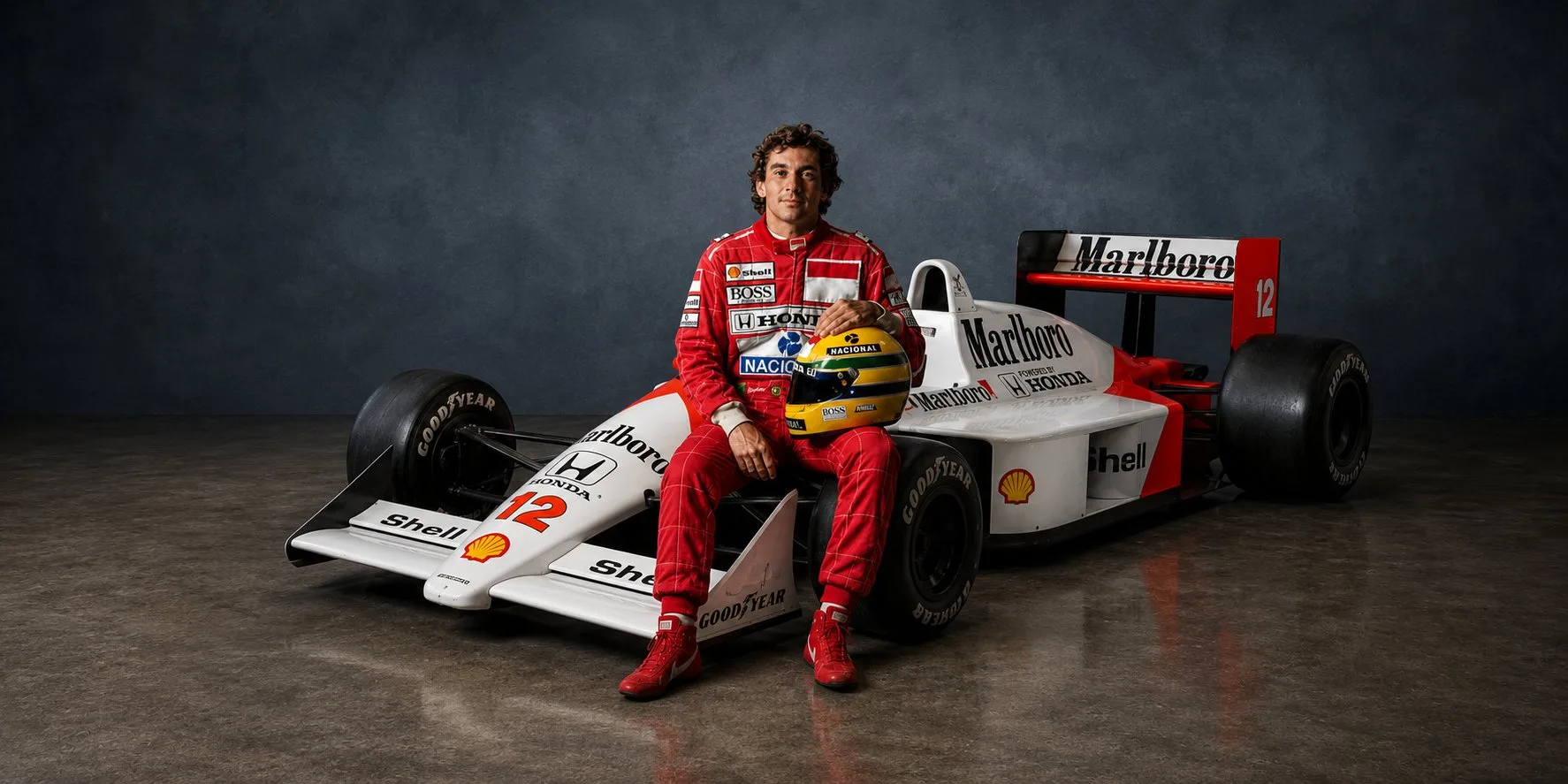
Senna’s professional path is unusually legible. He moved from karting into British junior formulae, won the 1983 British Formula 3 Championship with West Surrey Racing, and entered Formula One with Toleman in 1984. From there, the climb was swift: Lotus gave him victories, McLaren gave him championships, and Williams became the final, unfinished chapter. His most productive period was with McLaren from 1988 to 1993. There, with Honda power at the centre of the most famous phase, Senna won all three of his World Drivers’ Championships. The McLaren years also fixed his image: yellow helmet, red-and-white car, Suzuka title decisions, and the rivalry with Alain Prost.
↓ Read deeper
Toleman was the proving ground. The team was not a front-running institution, which made Senna’s 1984 performances more revealing. Monaco gave him the public stage, but the season as a whole showed that he could drag consequence from limited machinery. Lotus gave him the machinery to win, and he answered immediately with victory in the rain at Estoril in 1985. The Lotus years were rich in speed, poles and promise, though not yet in championship structure. He was becoming a force before he had the complete weapon. McLaren supplied that weapon. In 1988, the McLaren-Honda partnership produced one of the most dominant seasons in Formula One history, and Senna won his first title. He followed with championships in 1990 and 1991. His move to Williams in 1994 was meant to open a new phase. It lasted only three Grands Prix.
Body of Work

What did it create?

Ayrton Senna’s notable works include his three Formula One world titles, his McLaren-Honda period, his Monaco record, his Honda NSX development feedback and his posthumous educational legacy.

Senna’s “works” are not objects in the manner of a designer’s portfolio. They are performances, championships, technical contributions and cultural consequences. verified His defining professional achievement was the trio of Formula One World Drivers’ Championships won with McLaren in 1988, 1990 and 1991. verified Several cars carry particular weight in the Senna story. verified The Toleman TG184 introduced him to the world at Monaco, the Lotus 97T gave him his first Grand Prix victory, the McLaren MP4/4 placed him inside one of Formula One’s most dominant machines, and the McLaren Senna later made his name part of a modern road-car mythology. verified
↓ Read deeper
The 1984 Monaco Grand Prix remains a foundational performance. verified Senna did not win, but second place in the rain for Toleman made the paddock understand that a new order had arrived. interpretation It was one of those rare races where defeat enlarges a driver’s reputation more than an ordinary victory could have done. interpretation His first Grand Prix victory came at the 1985 Portuguese Grand Prix at Estoril, driving for Lotus. verified Again, rain was part of the story, and again the impression was of a driver whose command of low grip made the car appear less compromised than those around it. interpretation The 1988 McLaren MP4/4 season gave Senna his first world title and fixed the McLaren-Honda-Senna triangle in motorsport culture. verified The Honda NSX connection belongs to another kind of work: Senna’s testing feedback is widely credited with influencing the car’s chassis and handling development, though detailed internal Honda engineering documentation should be used for final archival verification. attributed
What are the stories behind it?

Monaco in the Rain

verified

Senna finished second for Toleman at the rain-shortened 1984 Monaco Grand Prix, establishing himself as a major Formula One talent.

The First Victory

verified

Senna won the 1985 Portuguese Grand Prix at Estoril for Lotus, his first Formula One victory.

The Prost Rivalry

verified

Senna and Alain Prost became title rivals and McLaren teammates, with their conflict defining the late 1980s and early 1990s in Formula One.

The Honda Bond

verified

Senna’s McLaren-Honda period produced three world titles and made him a revered figure in Honda’s Formula One story.

The NSX Feedback

attributed

Senna’s testing feedback is widely credited as part of the original Honda NSX development story, especially around handling and chassis feel.

Interlagos 1991

verified

Senna won his home Grand Prix in Brazil in 1991 after mechanical difficulties made the final laps physically demanding.

Imola 1994

verified

Senna died after his accident at Tamburello during the 1994 San Marino Grand Prix, a weekend that also claimed Roland Ratzenberger.

Connected Graph

PERSON

COMPETES WITHAlain Prost
PERSONSTUB

THEME

BELONGS TO THEMEFormula One
THEMESTUB
BELONGS TO THEMEInstituto Ayrton Senna
THEMESTUB
BELONGS TO THEMESuzuka Circuit
THEMESTUB
BELONGS TO THEMEBrazilian Motorsport
THEMESTUB
Encyclopedia
4 sections
legacy

What did it leave behind?

Editorial inference

Ayrton Senna’s legacy spans Formula One performance, Brazilian national memory, driver safety debates, Honda and McLaren history, and education through Instituto Ayrton Senna.

Senna’s legacy is unusually broad because it operates on several levels at once. Within Formula One, he remains a benchmark for qualifying speed, wet-weather control and competitive intensity. Within Brazil, he remains a national figure whose victories carried emotional force far beyond sport. His death also marks a boundary in Formula One’s modern memory. Imola 1994 became a point after which safety could no longer be discussed in the old language. The sport had already known danger; after Senna, it confronted danger under global grief.
motorsport-competition

Did it race?

Editorial inference

Ayrton Senna competed in Formula One from 1984 to 1994 and won world titles in 1988, 1990 and 1991.

Senna’s motorsport story is built from escalation. Toleman showed the talent, Lotus supplied the first victories, McLaren delivered the championships, and Williams represented the future that never arrived. The career was only a decade long at the highest level, yet it altered the grammar of Formula One greatness. His rivalry with Alain Prost remains the central competitive relationship of his career. Prost was calculation, rhythm and political intelligence; Senna was intensity, attack and absolute claim. This contrast can be simplified too easily, but the tension between them gave Formula One one of its defining dramatic structures.
myths-misconceptions

What do people get wrong about it?

Editorial inference

Common myths about Ayrton Senna concern whether he was only a rain specialist, whether he relied mainly on superior cars, and whether the Honda NSX was designed by him.

Myth: Senna was only great in the rain. myth Truth: wet-weather drives are central to his reputation, but his record also includes three world titles, 65 pole positions and victories across many conditions. verified Myth: Senna’s success was simply the result of dominant McLaren-Honda machinery. myth Truth: McLaren-Honda was central to his title years, but Senna had already shown front-running ability at Toleman and Lotus, and his qualifying record extended across different teams and eras. verified
pop-culture-sightings

What does it mean in culture?

Editorial inference

Ayrton Senna has been represented in documentary film, television drama, games, branded road cars and public memorial culture.

Senna’s popular-culture life is not secondary to his racing history. verified It is one of the ways the racing history has survived. interpretation The 2010 documentary Senna by Asif Kapadia helped introduce him to a broader global audience through archival footage rather than conventional talking-head biography. verified The Netflix limited series Senna, released in 2024, dramatised his life for a streaming-era audience, with Gabriel Leone portraying him. verified The McLaren Senna road car turned his name into a modern performance object, while Gran Turismo and other racing-game culture have kept his cars and era accessible to younger enthusiasts. verified
Sources & Confidence
Senna’s life is well documented, but it is also heavily mythologised. Verification should therefore separate race record, technical contribution, personal testimony and cultural interpretation. The lap times and results are one layer; the meaning built around them is another. The most sensitive areas are the Prost rivalry, Suzuka 1989 and 1990, the Honda NSX development story, private life, religious language and the circumstances around Imola 1994. These subjects require disciplined sourcing because they attract exaggeration.
Questions readers ask

How many Formula One championships did Ayrton Senna win?

Ayrton Senna won three Formula One World Drivers’ Championships, in 1988, 1990 and 1991.

Which Formula One teams did Ayrton Senna drive for?

Senna drove for Toleman in 1984, Lotus from 1985 to 1987, McLaren from 1988 to 1993, and Williams in 1994.

How many Formula One races did Ayrton Senna win?

Senna won 41 Formula One Grands Prix.

What was Ayrton Senna’s relationship with Alain Prost?

Prost was Senna’s most famous rival and his McLaren teammate in 1988 and 1989. Their rivalry shaped the 1988, 1989 and 1990 title narratives.

Did Ayrton Senna help develop the Honda NSX?

Senna did not design the Honda NSX, but his testing feedback is widely credited as part of the car’s development story.

Why is the McLaren Senna named after Ayrton Senna?

McLaren named the car after Ayrton Senna to honour his achievements and identity with the McLaren Formula One team.

When did Ayrton Senna die?

Ayrton Senna died on 1 May 1994 after an accident during the San Marino Grand Prix at Imola.

What is Instituto Ayrton Senna?

Instituto Ayrton Senna is a Brazilian education organisation founded by Viviane Senna after Ayrton Senna’s death to continue his social legacy.

Ayrton Senna | Brazilian Formula One Champion | Engine Sphere