Engine Sphere · Design House
Pininfarina
Italian design and engineering consultancy founded in 1930, responsible for the Cisitalia 202 and decades of Ferrari's road-car styling.
Country
Italy
The House
What is it?
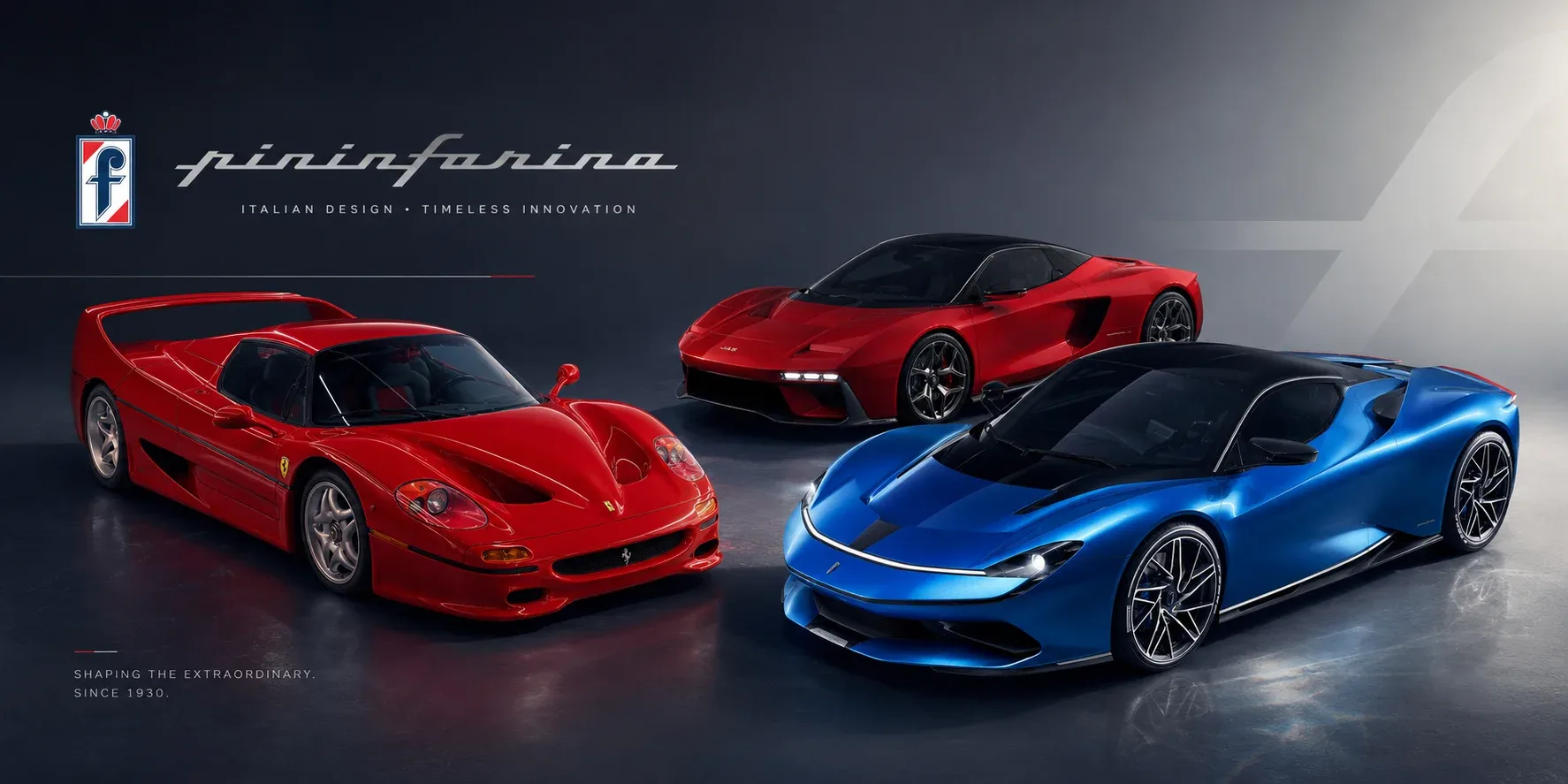
Pininfarina is an Italian design and engineering consultancy in Turin, once one of the automotive industry's great coachbuilders, now a styling, aerodynamics and industrial-design house majority-owned by India's Mahindra Group.
↓ Read deeper↑ Less
For most of the twentieth century, Pininfarina built cars as well as designing them. That changed on 10 December 2011, when its automotive manufacturing operation formally closed, the plant itself having stopped production the previous November. What remains is the design and engineering side of the business: styling, aerodynamic and structural research, and industrial design work that now extends well beyond cars. The company is listed on the Milan Stock Exchange under the ticker PINF, and since 14 December 2015 has been majority-owned by the Mahindra Group, which acquired 76.06 percent of the business for roughly €168 million.
Origins
How did it begin?
Battista 'Pinin' Farina founded the company with his brother Giovanni in Turin, incorporated on 22 May 1930 as Società Anonima Carrozzeria Pinin Farina, after operating informally since 1928.
↓ Read deeper↑ Less
'Pinin' is Piedmontese for 'the little one', a nickname tied to Battista's short stature, and it stuck to both the man and the company for three decades. In 1961, the Italian President formally authorised the legal name change to Pininfarina, coinciding with Battista handing leadership to his son Sergio and son-in-law Renzo Carli. Some sources give the incorporation date as 23 May 1930 rather than 22 May; this profile follows the company's own stated date and the majority position among historical sources.
Design Philosophy
What does it stand for, visually?
Pininfarina's design language is consistently described, across decades of critical writing, as proportion-led and restrained: elegance built from clean surfacing rather than ornament.
↓ Read deeper↑ Less
No single Pininfarina mission statement defines the house's design philosophy; it is better read from the work itself, and from the consistent editorial language used to describe it across nearly a century of cars. The recurring theme is a Pininfarina line that resolves proportion before decoration, favouring clean surfacing, careful stance, and a refusal to over-style. This is an editorial characterisation drawn from consistent critical consensus, not a direct company quote.
Engineering Philosophy
How does it engineer?
Pininfarina has always been more than a styling house: its Studies and Research Centre, opened in Grugliasco in 1966, gave the company its own wind tunnel and calculation facilities well before most rivals had either.
↓ Read deeper↑ Less
The Calculation and Design Centre opened in 1967, followed in 1972 by a full-scale wind tunnel, described by the company as the first in Italy capable of testing full-size cars and among the first of its kind anywhere. This is the part of Pininfarina's identity that separates it from a pure styling studio: aerodynamic and structural engineering have been in-house disciplines here since the 1960s, not outsourced work bought in afterward.
Notable Works
What did it create?
The Cisitalia 202 (1946) is Pininfarina's most historically significant single work: it entered the Museum of Modern Art's permanent collection in New York in 1972, the first car ever to do so.
↓ Read deeper↑ Less
The Cisitalia first appeared publicly in MoMA's landmark 1951 exhibition 'Eight Automobiles', curated by Arthur Drexler, who called it 'rolling sculpture' alongside a 1930 Mercedes SS, a 1937 Cord 812 and a 1948 MG TC. Its formal entry into MoMA's permanent collection in 1972 remains the clearest evidence that a Pininfarina design was, at least once, treated as fine art rather than industrial product. On the Ferrari side, Leonardo Fioravanti's 1975 Ferrari 308 GTB, unveiled at the Paris Motor Show, is the design directly responsible for the pop-up headlights this archive already catalogues as a real badge: a wedge nose and eggcrate grille that required retractable units rather than the fixed round lamps of the decade before. Pininfarina styled virtually every road-going Ferrari from 1951 through the F12berlinetta (2012-2017), with one well-documented exception: the 1973 Dino 308 GT4 was designed by Bertone, not Pininfarina, a genuine correction to the broader, sometimes-overstated claim that the house designed every Ferrari of that era. Beyond Ferrari, the house's catalogue includes the Alfa Romeo Giulietta Spider, the Lancia Flaminia, the Peugeot 404 and 504, the Fiat 124 Sport Spider, the Cadillac Eldorado Brougham, and the 1958 BMC 'Farina' saloons sold across five badges (Austin, Morris, Riley, MG, Wolseley).
Key People
Who shaped it?
Leadership passed through three generations of the Farina/Pininfarina family: Battista (1930-1961), his son Sergio (1961-2001), and his grandsons Andrea (2001-2008) and Paolo (2008-2024).
↓ Read deeper↑ Less
Battista 'Pinin' Farina (1893-1966) founded the company and led it until 1961. His son Sergio Pininfarina (1926-2012) ran the business for the following four decades, and in 1969 joined Ferrari's own board of directors, a formal recognition of just how entangled the two companies' fortunes had become; he later served as an Italian senator for life and sat in the European Parliament from 1979 to 1988. Sergio's grandson Andrea Pininfarina led the company from 2001 until his death in 2008, after which his younger brother Paolo Pininfarina took over, leading until his own death in April 2024. Leonardo Fioravanti, the house's chief designer through the 1960s and 70s, is credited with the 308 GTB, the Daytona 365 GTB/4, and the Dino, a body of work that makes him one of the most influential individual designers in the company's history.
Designs That Carry Its Signature
Connected Graph
MANUFACTURER
Encyclopedia7 sections
Model Catalogue
What are its defining models?
Journalistic
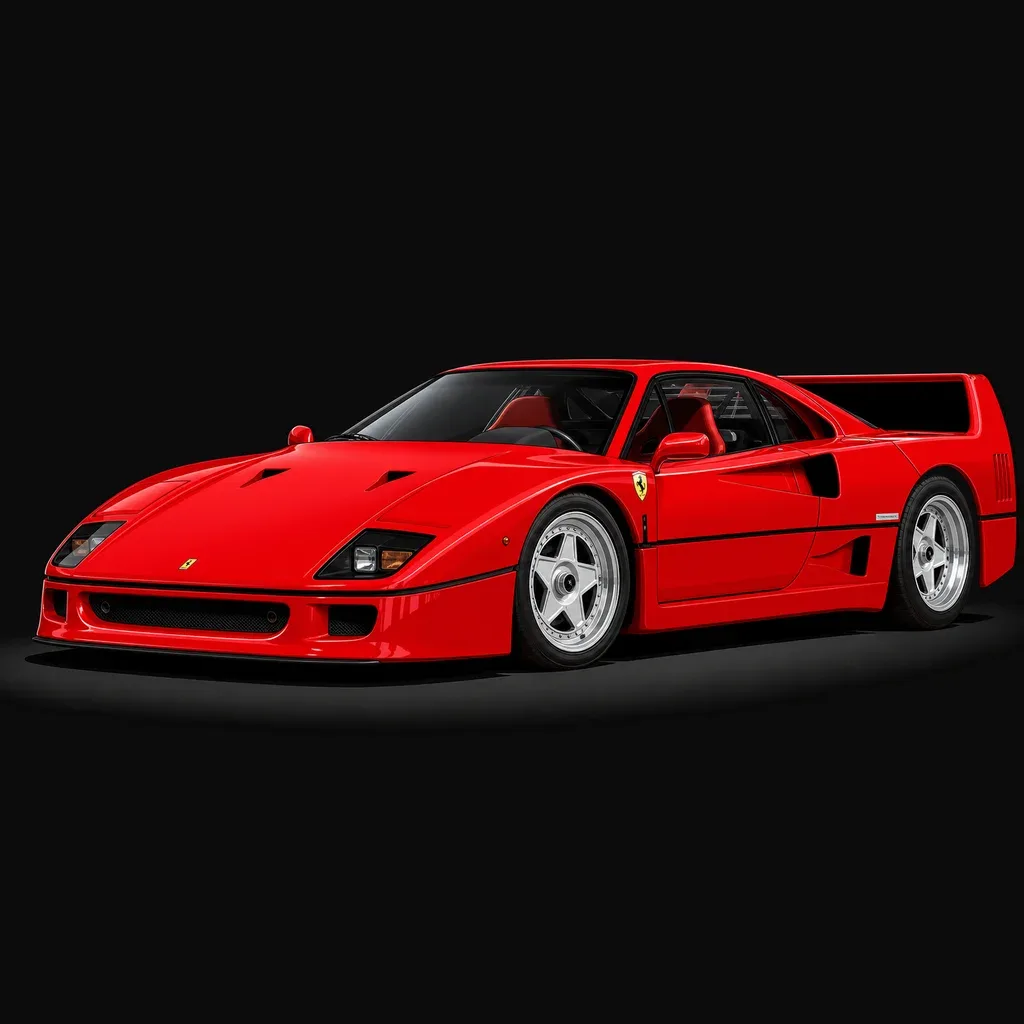
A curated span of Pininfarina's most historically significant designs, from the 1946 Cisitalia 202 through the Ferrari F40 and 288 GTO already catalogued on this site.
Motorsport / Competition Link
Did it race?
Journalistic
Pininfarina has never fielded its own racing team; its motorsport relevance runs indirectly, through road and homologation cars it designed that were later raced by others.
Timeline / Evolution
How did it evolve?
Journalistic
From an informal Turin coachbuilder in 1928 to a publicly listed design and engineering consultancy majority-owned by an Indian conglomerate: roughly a century of continuous, changing identity.
Rivals & Affiliations
What did it compete against?
Journalistic
Pininfarina sits among a small group of great Italian carrozzerie, alongside Bertone, Italdesign, Zagato, Ghia, and Touring Superleggera, each with its own house style and client roster.
Pop Culture & Sightings
What does it mean in culture?
Journalistic
Pininfarina's own name carries less independent pop-culture recognition than the cars it designed, which have carried its work into decades of film, television and games under their own badges.
Myths, Rumors & Misconceptions
What do people get wrong about it?
Journalistic
The most common overstatement about Pininfarina is that it designed every road-going Ferrari of a given era without exception; the 1973 Dino 308 GT4, styled by rival house Bertone, is the clearest documented counterexample.
Legacy
What did it leave behind?
Journalistic
Pininfarina is widely credited as one of the two or three most influential automotive design houses of the twentieth century, its standing anchored by the Cisitalia 202's unique status as the first car in MoMA's permanent collection.
Sources & Confidence
Sourced from Pininfarina's own company history, Wikipedia, and MoMA-adjacent design-history material, cross-checked wherever more than one source was available.