British manufacturer of carbon-fibre road and track cars, founded in 2010 in Woking, England, to bring McLaren's Formula One engineering discipline to series production.
Catalogued Entry No. 019
Founded
Est. 2010
Founder
Ron Dennis
Status
Active
Parent Company
McLaren Group
Headquarters
Woking, Surrey, England
Industry Focus
Carbon-fibre sports and supercars
The House
What is it?
McLaren Automotive is, deliberately, not a company with decades of road-car heritage, it exists because McLaren's motorsport arm decided, in 2010, that the engineering standards developed for Formula One (carbon-fibre monocoque construction chief among them) deserved a permanent road-car outlet beyond the sporadic, low-volume experiments the wider McLaren Group had made before. Every subsequent road car, from the 12C onward, has been built around a carbon-fibre tub, a construction method every rival supercar maker eventually adopted, but which McLaren treated as non-negotiable from its very first production model.
The company's relationship to the McLaren name that preceded it by nearly half a century is best understood as inheritance rather than continuity: the racing team founded by Bruce McLaren in 1963 and the road-car company founded in 2010 share ownership, a technology centre, and an engineering ethos, but McLaren Automotive itself is a genuinely new enterprise, not a reactivated one.
↓ Read deeper↑ Less
The clearest link between McLaren's racing past and its road-car present is not corporate but singular: the McLaren F1 (1992), designed by Gordon Murray as arguably the purest road car Formula One thinking ever produced, a carbon-fibre monocoque, a centrally seated driver, and no driver aids whatsoever, built by McLaren Cars, a short-lived road-car venture (1985–1992) distinct from today's McLaren Automotive. That car proved the concept and then the venture folded; road-car production did not resume for eighteen years.
McLaren Automotive's 2010 founding, under McLaren Group chairman Ron Dennis, was explicitly designed to avoid a repeat of that stop-start history: rather than a boutique halo-car project, it was structured as a full manufacturing operation, with its own factory (the McLaren Production Centre, adjoining the McLaren Technology Centre) built to sustain continuous model lines rather than one-off flagships. The 12C (2011) was the first fruit of that structure, followed by an entire model hierarchy, Sports, Super, and Ultimate Series, all sharing the carbon-tub philosophy the F1 had first proven.
The company has weathered real financial strain since: McLaren Automotive required significant capital injections and an ownership restructuring in the early 2020s, with the Bahrain sovereign wealth fund Mumtalakat becoming majority shareholder, a reminder that even a manufacturer built entirely around motorsport-derived engineering discipline is not immune to the brutal economics of low-volume, high-cost car manufacturing.
Origins
How did it begin?
McLaren Automotive's founding in 2010 was a conscious correction of history. McLaren Cars, the road-car venture active from 1985 to 1992, had produced exactly one model, the extraordinary F1, before winding down; for nearly two decades afterward, McLaren's road-car ambitions existed only as occasional special projects (the SLR McLaren, built with and largely for Mercedes-Benz) rather than a business in its own right.
McLaren Group chairman Ron Dennis pushed to change that, establishing McLaren Automotive as a properly resourced, continuously operating manufacturer rather than a boutique one-off project, a structure built to sustain an entire model range rather than a single halo car.
↓ Read deeper↑ Less
The distinction between McLaren Racing (the Formula One team, tracing to Bruce McLaren's 1963 founding), McLaren Cars (the 1980s–90s F1 road-car venture), and McLaren Automotive (the 2010-founded modern manufacturer) is a source of frequent public confusion but matters for accuracy: they are three legally and operationally separate ventures, unified by shared ownership under the McLaren Group holding structure and by a continuous engineering culture, but not a single continuously operating car company.
The construction of the McLaren Production Centre, a dedicated factory adjoining Norman Foster's McLaren Technology Centre, signalled the seriousness of the 2010 venture: unlike a low-volume specialist workshop, the facility was designed from the outset for sustained series production of carbon-fibre monocoque cars, beginning with the MP4-12C in 2011.
The 2020s brought the company's most serious financial test since founding: pandemic-era sales disruption combined with heavy R&D spending forced McLaren Group into a significant refinancing, culminating in Bahrain's Mumtalakat sovereign wealth fund, already a long-standing shareholder in the wider McLaren Group, taking majority ownership, a restructuring that ensured the automotive division's continued operation through a genuinely difficult period for low-volume supercar manufacturers generally.
Design Philosophy
What does it stand for, visually?
McLaren's design language is distinguished by an unusually strict subordination of styling to aerodynamic function: surfaces, vents, and body creases across the lineup are typically justified first by airflow management (cooling, downforce, drag reduction) and only secondarily by visual appeal, a discipline traceable directly to the company's Formula One engineering culture, where form has always followed function by necessity.
This produces a design signature that is more technical and less overtly emotional than some Italian rivals' styling language, McLarens tend to look purposeful and slightly understated at a glance, with their true visual drama concentrated in functional details (dihedral doors, exposed aerodynamic surfaces) rather than dramatic overall silhouettes.
↓ Read deeper↑ Less
The McLaren F1's design (1992), overseen by Gordon Murray, established the philosophy in its purest form: the car's central driving position existed purely for functional reasons (better visibility and a more natural steering position, unencumbered by pedal-box offset), not for visual novelty, even though it became one of the car's most visually distinctive and widely discussed features.
McLaren Automotive's modern lineup (12C onward) has consistently used a "shrink-wrap" design approach, minimizing surface area and visual bulk around the carbon-fibre monocoque's actual structural requirements, a philosophy the company's designers have explicitly described as prioritizing aerodynamic efficiency and lightweight construction over dramatic sculptural flourishes favored by some rivals.
The distinctive dihedral doors used across McLaren's modern lineup, while visually dramatic, are justified internally on functional grounds (structural rigidity of the door-sill area, and practical entry/exit given the car's low, wide proportions) rather than as pure styling theater, consistent with the brand's stated design priorities.
Engineering Philosophy
How does it engineer?
McLaren's engineering identity is inseparable from carbon-fibre construction: every road car since the 12C (2011) has been built around a carbon-fibre monocoque tub, a construction method the McLaren F1 first proved on the road in 1992 and which every subsequent rival supercar maker eventually adopted, but which McLaren treats as foundational rather than optional, unlike manufacturers who reserve carbon construction for halo models only.
This engineering discipline extends to a broader philosophy of minimizing weight and maximizing structural rigidity as the primary design constraints, with power output treated as a secondary lever compared to the chassis and aerodynamic engineering that Formula One experience made McLaren's genuine specialty.
↓ Read deeper↑ Less
The McLaren F1's carbon-fibre monocoque (1992) was, at the time, a genuinely radical proposition for a road car, carbon construction was until then almost exclusively a Formula One and aerospace technique, and Gordon Murray's insistence on using it for a road-legal production car (rather than a conventional steel or aluminum structure) was itself a significant engineering risk that took years to fully validate in a consumer product.
McLaren Automotive's modern Monocell/Monocage carbon-fibre tub architecture (evolving across the 12C, 650S, 720S, and subsequent models) represents a direct engineering descendant of the F1's original approach, refined through McLaren's ongoing Formula One racing programme's parallel materials-science development.
The company's Sports, Super, and Ultimate Series model hierarchy reflects an engineering philosophy of applying the same core carbon-tub construction principle across a genuine model range rather than reserving it for one halo car, a structural commitment distinguishing McLaren from rivals who use carbon construction more selectively.
Notable Works
What did it create?
The McLaren F1 (1992), though built by the earlier, distinct McLaren Cars venture rather than today's McLaren Automotive, remains the single work most responsible for the entire modern company's engineering philosophy, its carbon-fibre construction and central-driving-position design proved concepts McLaren Automotive's later cars would build directly upon decades later.
The P1 (2013) represents McLaren Automotive's own most significant standalone achievement: a hybrid hypercar explicitly positioned as the F1's spiritual successor, combining a twin-turbo V8 with electric motor assistance in a way that anticipated the broader hypercar industry's later shift toward hybridization.
↓ Read deeper↑ Less
The McLaren F1's engineering ambition extended beyond the road car itself into a genuinely dominant, if unplanned, motorsport career: the GTR racing variant won the 1995 24 Hours of Le Mans outright on what was essentially its competition debut, an achievement rarely matched by a road-car-derived racer entering top-level endurance competition for the first time.
The P1's hybrid powertrain (a twin-turbo 3.8L V8 paired with an electric motor delivering a combined output exceeding 900 hp) was developed alongside McLaren's Formula One KERS energy-recovery technology, representing a direct transfer of racing hybrid engineering into a road car years before hybrid hypercars became an established category norm.
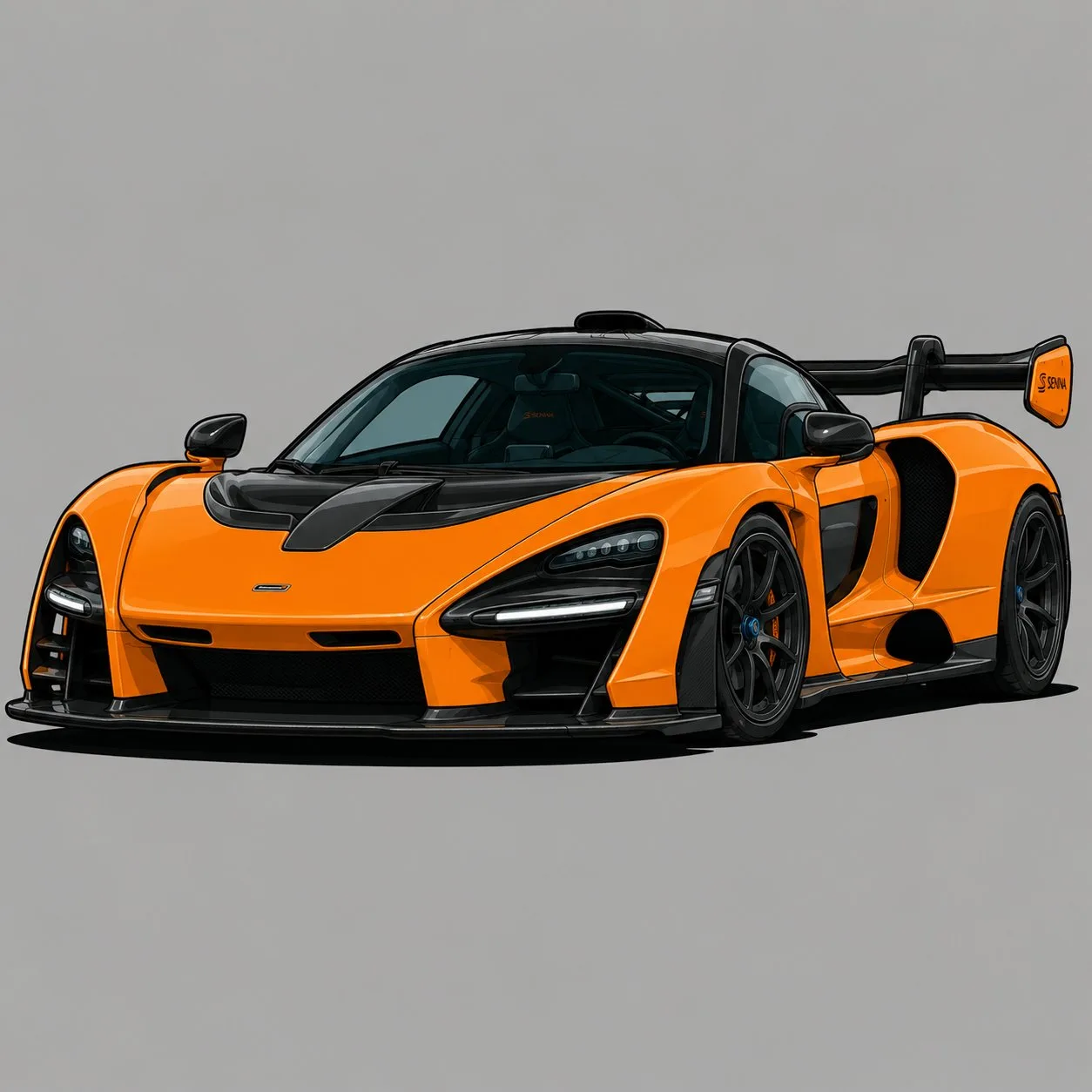
McLaren Automotive's Senna (2018), named for Ayrton Senna and built as an even more extreme, track-focused evolution of the marque's engineering priorities, represents the company's continued willingness to build genuinely uncompromising, low-volume halo products alongside its more commercially essential Sports Series models.
Key People
Who shaped it?
McLaren Automotive's key figures split across two eras separated by nearly two decades: Gordon Murray, chief designer of the 1992 McLaren F1 built by the earlier, distinct McLaren Cars venture, and Ron Dennis, the long-time McLaren Group chairman who pushed for a properly resourced, continuously operating road-car manufacturer rather than a repeat of the F1's one-off, boutique approach.
Bruce McLaren himself, founder of the racing team in 1963, predates both by decades and never worked on a road car, his relevance to McLaren Automotive is one of shared heritage and namesake rather than direct involvement.
↓ Read deeper↑ Less
Gordon Murray, already an established Formula One chief designer (having led Brabham and later McLaren's own F1 chassis programmes), was given an unusually open brief for the McLaren F1, build the best road car possible with no cost constraint, and delivered a carbon-fibre monocoque, centrally-seated, naturally aspirated V12 road car with no driver aids whatsoever, a design philosophy still referenced by McLaren Automotive's engineers as a founding influence decades later.
Ron Dennis, who led the McLaren Group for decades as Formula One team principal and chairman, was the driving corporate force behind McLaren Automotive's 2010 founding, pushing to establish a genuine, sustained manufacturing operation (the McLaren Production Centre) rather than repeat the F1's short-lived, low-volume model.
Bruce McLaren founded the racing team that eventually became McLaren Group in 1963, and died in a testing accident in 1970, four decades before McLaren Automotive existed as a company, his connection to the modern road-car business is one of inherited name and engineering culture, not personal involvement.
While McLaren Automotive and McLaren Racing (the Formula One team) are legally and operationally separate entities within the wider McLaren Group, they share engineering culture, facilities, and, periodically, direct technology transfer, most visibly in the P1's hybrid powertrain development alongside Formula One KERS technology.
The clearest direct motorsport triumph tied to McLaren's road-car engineering is the F1 GTR's outright win at the 1995 24 Hours of Le Mans, achieved on the car's competition debut, a rare feat for a road-car-derived racer entering top-level endurance competition for the first time.
rivals-comparisons
What did it compete against?
Editorial inference
McLaren's modern Super Series and Ultimate Series cars compete most directly against Ferrari's and Lamborghini's equivalent mid-engine offerings, with the motoring press frequently framing McLaren's more overtly aerodynamics-and-carbon-fibre-focused engineering approach against Ferrari's more emotionally-styled, racing-heritage-driven identity.
The P1's most famous rivalry was a specific, celebrated three-way comparison: alongside the Ferrari LaFerrari and Porsche 918 Spyder, all three launched within roughly a year of each other as hybrid hypercars, forming what the automotive press dubbed the "holy trinity", a rare instance of three direct competitors from different manufacturers arriving at a strikingly similar technical solution simultaneously.
myths-misconceptions
What do people get wrong about it?
Editorial inference
Claim: McLaren Automotive is the same continuously operating company that built the McLaren F1 in 1992. Truth: the F1 was built by McLaren Cars, a distinct road-car venture active only from 1985 to 1992; McLaren Automotive is a separate company founded in 2010, sharing ownership under the McLaren Group and an engineering heritage, but not a direct continuous operating history, there was an 18-year gap with no dedicated McLaren road-car manufacturer at all. verified
Claim: McLaren Automotive and the McLaren Formula One team are the same organization. Truth: they are legally and operationally distinct entities (McLaren Automotive and McLaren Racing) under the shared McLaren Group holding structure, related, and sharing some engineering culture and facilities, but not a single unified company. verified
legacy
What did it leave behind?
Editorial inference
McLaren Automotive's most significant legacy is institutionalizing what the F1 first proved as a one-off achievement: that Formula One-derived carbon-fibre construction belongs in road cars as a standard, not an exception. Every subsequent McLaren model since the 12C has built on this foundation, and the broader supercar industry's own gradual adoption of similar carbon-fibre techniques stands as indirect validation of the approach McLaren pioneered.
The company's survival through a serious early-2020s financial crisis, while continuing to produce genuinely engineering-led halo cars (Senna, Speedtail), also stands as a case study in how difficult, and how important, sustained institutional commitment is for a low-volume, high-engineering-cost manufacturer to survive across economic cycles.
model-catalogue
What are its defining models?
Editorial inference
Because McLaren Automotive was only founded in 2010, decades after the standalone McLaren F1 (1992) built by the earlier, distinct McLaren Cars venture, its own catalogue as a continuously operating manufacturer spans just over a decade of models, genuinely fewer than older rivals with a much longer road-car history. Rather than pad this list toward an artificial round number, it lists the models that are genuinely distinct engineering generations or halo statements.
The McLaren F1 itself is included for completeness of the broader McLaren automotive lineage, though it was built by the earlier McLaren Cars venture, not McLaren Automotive proper.
timeline-evolution
How did it evolve?
Editorial inference
McLaren Automotive's own history is short but eventful: founded in 2010 specifically to avoid repeating the stop-start pattern of the earlier McLaren Cars venture (which built only the F1 before folding in 1992), the company built a genuine, continuously operating manufacturing base before facing a serious financial crisis in the early 2020s that required a significant ownership restructuring to resolve.
The distinction between McLaren Cars (1985–1992, built the F1), McLaren Racing (the Formula One team, founded 1963), and McLaren Automotive (founded 2010) is a frequent source of public confusion but matters for accurately understanding the company's actual timeline.
pop-culture-sightings
What does it mean in culture?
Editorial inference
The McLaren F1's road-legal top speed record (240.1 mph, set in 1998) gave it a mythological status in automotive culture that persisted for years afterward, referenced repeatedly in car magazines, documentaries, and racing video games as the benchmark against which subsequent hypercars were measured, a status reinforced by the car's extreme rarity (only 106 examples built across all variants).
McLaren Automotive's modern cars (particularly the P1 and Senna) have continued this tradition of being featured prominently in racing simulation games, introducing the brand's engineering identity to audiences who may never encounter one in person given the marque's low production volumes.
Sources & Confidence
Claims in this profile draw on categories of source material appropriate to their confidence level: company-published corporate history for founding dates and the McLaren Cars/McLaren Automotive distinction; Le Mans official results for the F1 GTR's 1995 win; and established automotive-history texts for design and engineering narrative.
Questions readers ask
When was McLaren Automotive founded?
McLaren Automotive was founded in 2010, as a dedicated, continuously operating road-car manufacturing arm of the McLaren Group.
Did McLaren Automotive build the original McLaren F1?
No. The F1 (1992) was built by McLaren Cars, a separate, earlier road-car venture active from 1985 to 1992, nearly two decades before McLaren Automotive existed.
Is McLaren Automotive the same as the McLaren Formula One team?
No. They are legally and operationally distinct entities (McLaren Automotive and McLaren Racing) that share ownership under the McLaren Group and some engineering culture, but operate as separate businesses.
What was McLaren Automotive's first production model?
The 12C, launched in 2011, was McLaren Automotive's first production car.
Who owns McLaren Automotive?
McLaren Automotive is owned by the McLaren Group; Bahrain's Mumtalakat sovereign wealth fund became the majority shareholder following an early-2020s financial restructuring.
McLaren Automotive: British Manufacturer | Engine Sphere