Article
Pininfarina: The Shape Before the Signature
From the Cisitalia 202 to Ferrari, Battista and the JAS Tensei, the Turin house built its reputation by resolving proportion before decoration.
August 5, 2026
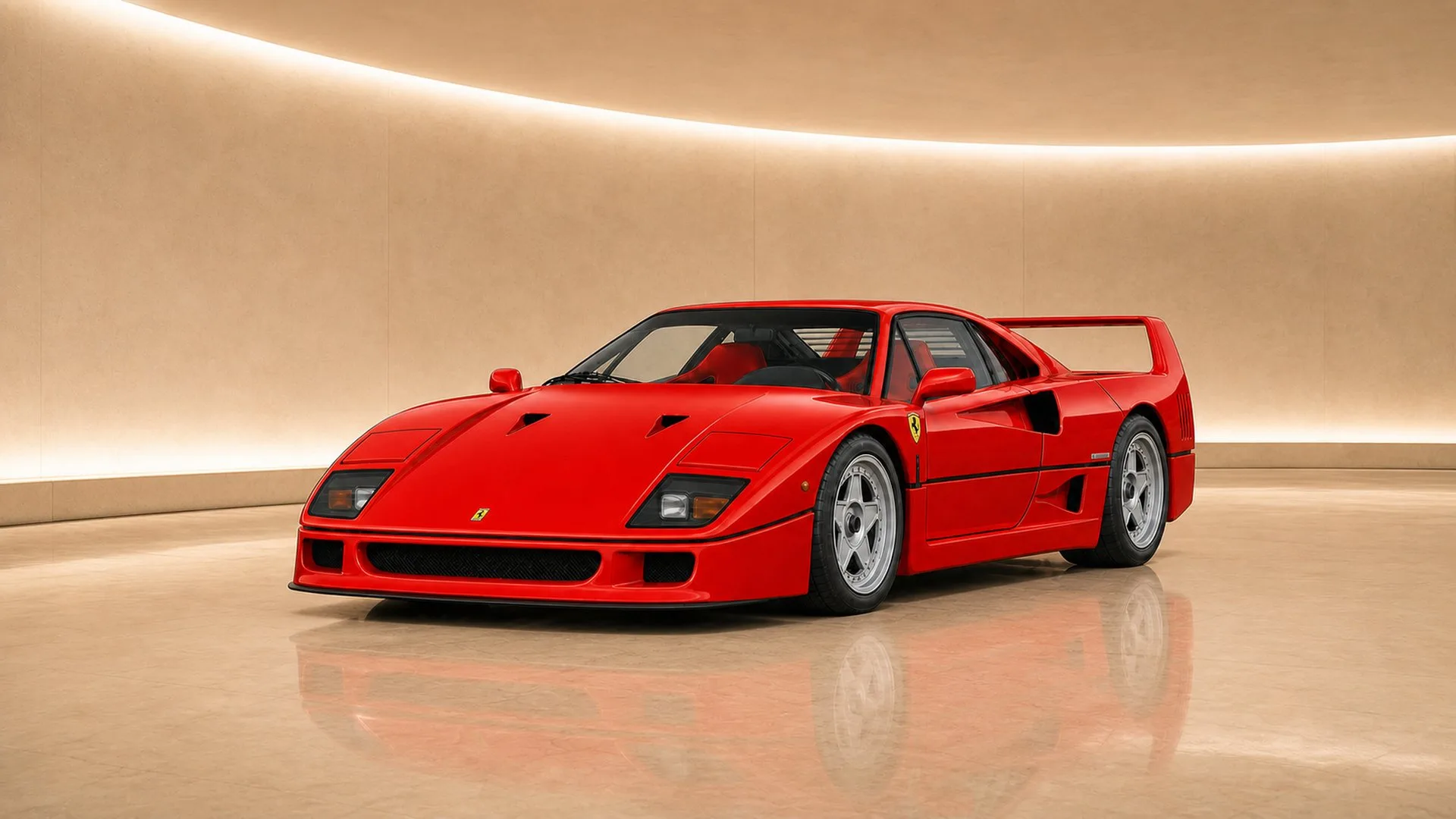
Its real signature was never a single curve. Pininfarina resolved the proportions first, from the museum-collected Cisitalia 202 through six changing decades of Ferrari to a car finally carrying its own name.
Pininfarina has spent almost a century drawing cars that do not need the badge explained.
That may be the most useful way to understand the house. Not as the company that gave Ferrari a certain nose, or Peugeot a certain coupé, or Italy a particular idea of elegance. Those are consequences. The deeper habit is simpler: establish the proportions, control the surface, remove what does not deserve to remain.
Battista Farina founded Carrozzeria Pinin Farina in Turin in 1930. The company would eventually design hundreds of machines for manufacturers across Europe, America and Asia, but the object that established its place in design history arrived remarkably early.
The Cisitalia 202 made the body read as one continuous volume. Bonnet, wings, cabin and tail belonged to each other rather than appearing as separate pieces assembled around a chassis. When the Museum of Modern Art exhibited the car in New York in 1951 and later added an example to its permanent collection, automotive design had crossed an institutional boundary. A car could be considered not simply transport, but industrial art.
Pininfarina had found its subject.
The Ferrari years were not one style
Ferrari and Pininfarina began working together in 1951. What followed is often described as a design partnership, which is accurate but incomplete. Over six decades, Pininfarina effectively became one of the principal authors of Ferrari's visual language.
The interesting part is how little that language stood still.
A 250 GT does not look like a Daytona. A Daytona does not look like a Testarossa. A Testarossa does not look like an F50. The Enzo would be difficult to mistake for any of them.
There is no single Pininfarina curve connecting the cars.
There is judgement.
The 250 GT generation carried long bonnets, compact cabins and remarkably little visual noise. The Dino lowered the mass and softened the transition between wings and cabin. The 365 GTB/4 Daytona stretched the front engined berlinetta almost to abstraction. The Berlinetta Boxer moved Ferrari's twelve cylinder centre of gravity behind the occupants. The 308 compressed the wedge into something remarkably clean.
Then the eighties arrived, and restraint became sharper.
The 288 GTO turned the familiar proportions of the 308 family into something wider, longer and considerably more serious. The Testarossa treated cooling requirements as architecture, making its side intakes impossible to separate from its identity. The F40 went further again. Openings, ducts, wing, glazing and composite panels became part of the visual grammar.
The changing forms matter more than any single styling device. Pininfarina survived fashion by refusing to confuse a fashion with its identity.
The F50 is where the argument becomes interesting
The Ferrari F50 deserves more attention than it usually receives.
The F40 before it had an obvious visual thesis. It was thin skinned, vented, winged and visibly aggressive. The Enzo after it would make Formula One influence explicit in its nose, aerodynamics and technical surfaces.
The F50 sits between them.
Pininfarina gave it no giant lateral strakes, no enormous rectangular intake dominating the side, and no attempt to repeat the F40's brutal graphic composition. Its body is softer, but not delicate. The front wings rise around a very low centre section. The cabin is pulled forward. The rear body appears to wrap tightly around the mechanical package. A black horizontal indentation visually reduces the car's mass and gives the side a line of tension without requiring another piece of decoration.
Underneath sat Ferrari's road interpretation of Formula One thinking, including a naturally aspirated V12 developed from the architecture of the 1990 Ferrari 641 racing engine and mounted as a structural element with the gearbox and rear suspension.
That engineering could easily have produced a caricature.
Pininfarina did something more difficult. It gave exotic hardware a body that could still be read as a Ferrari rather than a catalogue of technical achievements.
The F50 is useful because it exposes the method. Pininfarina did not make every important car look simple. It made complexity legible.
More than Ferrari
Ferrari dominates the Pininfarina story because the relationship was unusually long and unusually productive. It should not be allowed to consume it.
The Alfa Romeo Giulietta Spider helped move Pininfarina from coachbuilding towards industrial production. The Alfa Romeo Spider Duetto became one of the most durable open car shapes of its period. Peugeot gave the studio the opportunity to translate Italian proportion into restrained French family cars and grand tourers. Fiat's 124 Sport Spider proved that a Pininfarina shape did not require Ferrari money. The Maserati Quattroporte and GranTurismo later showed that the same hand could give a large four seat car presence without simply making it larger, louder or busier.
Even the engineering infrastructure became part of the design language. Pininfarina opened its full scale wind tunnel in 1972, the first in Italy and one of very few facilities of its kind at the time. Aerodynamics ceased to be something imposed on the finished drawing. It could participate in the drawing itself.
That distinction matters.
A styling studio decorates a package.
A design house helps decide what the package should become.
A partial register
A complete Pininfarina catalogue would overwhelm this article. The company's own historical publication records hundreds of projects. A more useful view is to place a selection on one long table and observe how often the name reappears.
Among its production cars, coachbuilt projects and major automotive designs are:
1940s and 1950s: Cisitalia 202, Nash Healey, Lancia Aurelia B24 Spider, Alfa Romeo Giulietta Spider, Ferrari 250 GT, Ferrari 250 GT SWB.
1960s: Lancia Flaminia Coupé, Peugeot 404, Alfa Romeo 1600 Spider Duetto, Fiat 124 Sport Spider, Ferrari Dino 206 GT, Ferrari Dino 246 GT, Ferrari 365 GTB/4 Daytona.
1970s: Peugeot 504 Coupé, Peugeot 504 Cabriolet, Ferrari 365 GTC/4, Ferrari 365 GT4 BB, Ferrari 308 GTB, Ferrari 308 GTS, Ferrari 512 BB, Ferrari 400, Rolls Royce Camargue.
1980s: Ferrari Mondial, Ferrari 288 GTO, Ferrari Testarossa, Ferrari 328 GTB, Ferrari 328 GTS, Ferrari F40.
1990s: Ferrari 348, Ferrari 456 GT, Ferrari F355, Ferrari F50, Peugeot 406 Coupé, Ferrari 550 Maranello.
2000s: Ferrari 360 Modena, Ferrari Enzo, Ferrari 612 Scaglietti, Maserati Quattroporte V, Ferrari F430, Maserati GranTurismo, Ferrari 599 GTB Fiorano, Ferrari California.
2010s: Ferrari 458 Italia, Ferrari FF and the F12berlinetta, the latter belonging to the final phase of collaboration between Pininfarina and Ferrari's own growing design organisation.
The contemporary chapter: Automobili Pininfarina Battista, Morgan Midsummer and JAS Tensei.
That list is already well beyond thirty cars and still leaves entire branches untouched.
The repetition is the point. Not repetition of shape, but repetition of relevance.
Battista changes the name on the nose
The Battista reverses an old relationship.
For decades, Pininfarina's work usually sat behind somebody else's badge. Ferrari received the recognition. Peugeot received the recognition. Alfa Romeo received the recognition. The small script on the body told those who cared where the line had come from.
The Battista puts Pininfarina on the front.
Named for Battista Pinin Farina, it became the first uniquely Pininfarina badged car. Its powertrain is electric, with four motors and a 120 kWh battery, but the more interesting shift is cultural. A house that spent generations defining other manufacturers was finally required to define itself.
There is no historical Ferrari grille to reinterpret. No Peugeot identity to respect. No Alfa Romeo lineage to continue.
The body therefore becomes a test of what Pininfarina believes remains after the client is removed.
The answer is revealing. The Battista is low and tightly wrapped, with a cabin visually contained between pronounced wheel volumes. The surfaces carry tension without accumulating decoration. Aerodynamic elements exist, but the car does not appear to have been assembled from aerodynamic elements.
For a company with such a long archive, making its own car could easily have resulted in nostalgia.
It did not.
Then an NSX returned to Turin
The JAS Tensei brings the story somewhere unexpected.
Its starting point is the first generation Honda NSX, one of the cars that helped redraw the supercar in the early 1990s. The Tensei is not a new Honda model. It is JAS Motorsport's first high performance road car, using the original NSX as its architectural basis and giving Pininfarina responsibility for the exterior and interior design.
This is a curious reunion.
Pininfarina had already worked with Honda on the HP-X concept in 1984, years before the production NSX appeared. Four decades later, the house returned to the idea of a Japanese mid engined sports car, this time with an existing icon rather than a blank sheet of paper.
The Tensei begins with architecture rather than ornament.
The original NSX platform is widened. The wheelbase is extended. The overhangs are reduced. Carbon fibre replaces the original exterior bodywork while key parts of the original structure and glasshouse remain. The result is recognisable without being a tracing.
That distinction is what makes the project important.
A poor reinterpretation remembers details.
A serious one remembers relationships.
The low cowl, canopy, side intake and concentration of visual mass around the engine remain legible as NSX ideas. Pininfarina then changes the stance, sections, shoulders and surface tension until the car belongs equally to the present.
It is scheduled to make its global public debut at the 2026 Paris Motor Show before the project moves towards customer cars.
The name Tensei means rebirth.
For once, the marketing term is unusually accurate.
The line survives the client
Ferrari eventually brought more of its design work inside Maranello. Pininfarina stopped series car manufacturing. Ownership changed. The studio expanded into architecture, transport, industrial design and other disciplines that Battista Farina could scarcely have imagined in 1930.
The automotive work remained.
That continuity is clearer in 2026 than it appeared a decade ago. Battista asks what happens when Pininfarina becomes the marque. Midsummer asks what happens when two old coachbuilding traditions meet. Tensei asks whether a Japanese supercar from the 1990s can be redrawn without being reduced to nostalgia.
They are very different questions.
Pininfarina's answer to each begins in roughly the same place: architecture, proportion, surface, detail.
In that order.
The house has drawn beautiful cars, difficult cars, ordinary cars, racing derived cars, family cars, grand tourers, electric hypercars and machines whose badges became more famous than the people who shaped them.
Its real signature was never a particular grille, lamp, intake or curve.
It was knowing what to leave alone.
Also in the Gazette
Pininfarina - The Drawing Room
Related Topics