German manufacturer of sports cars and performance SUVs, founded in Stuttgart in 1931 and defined by six decades of continuous refinement of the rear-engined 911.
Porsche occupies a curious position in the automotive world: a manufacturer whose reputation rests less on constant reinvention than on the patient, obsessive refinement of ideas it settled on decades ago. Where rivals chase each new body style and market segment, Porsche has spent generations proving that a rear-engined coupé first sketched in the early 1960s can still humble purpose-built exotics on a racetrack in the 21st century. The company's engineering culture, forged in the lean postwar years and hardened at Le Mans, treats the racetrack not as marketing but as a laboratory, nearly every road-going innovation Porsche has introduced, from disc brakes to dual-clutch transmissions to active aerodynamics, first proved itself in competition.
Today the marque spans far beyond the 911 that built its name: the Cayenne and Macan SUVs now account for the bulk of its sales, funding motorsport and the continued existence of niche, low-volume halo cars. Yet the company's self-image remains stubbornly sports-car-first, and its engineering department continues to treat every model, however practical its brief, as an object that must also be genuinely satisfying to drive.
↓ Read deeper↑ Less
Porsche's technical identity was set early and has proved remarkably durable. The air-cooled flat-six, mounted behind the rear axle in defiance of orthodox chassis engineering, became the 911's signature the moment it appeared in 1963, a layout inherited from the humbler Volkswagen Beetle that Ferdinand Porsche himself had engineered decades earlier, refined into something altogether more serious. The arrangement is famously difficult to get right (weight hung behind the rear wheels invites lift-off oversteer if mishandled) and Porsche's decades of chassis development to tame it, rather than abandon it, is arguably the company's single defining engineering achievement.
That same conservatism-in-service-of-mastery shows in Porsche's approach to motorsport. Rather than campaigning wildly different cars for each category, Porsche has repeatedly built dynasties around a small number of chassis platforms, run for a decade or more with continuous development, the 911-based GT racers, the 917, the 956/962 Group C cars, and later the 919 Hybrid LMP1 programme. This is a company that measures success in Le Mans overall wins (more than any other manufacturer) and treats each one as validation of an engineering philosophy, not just a trophy.
Financially and structurally, Porsche's story since the 2000s has been inseparable from Volkswagen: a failed takeover attempt of VW by Porsche's holding company in 2008–09 ended, improbably, with Volkswagen acquiring Porsche instead, and the sports car maker now operates as a distinct, IPO'd brand (Porsche AG, listed since 2022) within the VW Group's orbit, a business structure as layered as one of its own flat-six engines.
Origins
How did it begin?
Ferdinand Porsche did not set out to build cars badged with his own surname. When he opened "Dr. Ing. h.c. F. Porsche GmbH" in Stuttgart in 1931, it was conceived as a contract engineering house, a consultancy that designed vehicles for other manufacturers to build. Its early commissions ranged from race cars for Auto Union to, most consequentially, the small, cheap, air-cooled "people's car" project that would become the Volkswagen Beetle, commissioned by the German government in the 1930s. For nearly two decades, Porsche's name appeared on drawings and patents, not on badges.
That changed after the Second World War. Ferdinand Porsche's son, Ferry Porsche, took the company in a new direction from its temporary base in Gmünd, Austria, building a small number of lightweight sports cars using Volkswagen components. The result, the 1948 Porsche 356, was the company's first car sold under its own name, and the direct ancestor, in layout and philosophy, of every 911 built since.
↓ Read deeper↑ Less
The consultancy years matter because they explain why Porsche's engineering culture reads so differently from a company that started by building road cars for the public. Ferdinand Porsche's practice was steeped in problem-solving for other clients' briefs, Grand Prix racers for Auto Union in the mid-1930s (the fearsome, mid-engined "Silver Arrows"), and the packaging puzzle of a cheap, durable, air-cooled family car for the German state. Both projects left a permanent imprint: the rear/mid-engine layout and torsion-bar suspension thinking that would resurface, transformed, in Porsche's own cars a decade later.
Ferry Porsche's decision to build a sports car under the family name was, by his own later account, a simple one: he wanted to drive a car that didn't yet exist, light, nimble, and built from parts a small postwar workshop could actually source, which meant raiding the Volkswagen parts bin his father had helped design. The first 356 was hand-built in Gmünd in a converted sawmill, using a shortened VW floorpan and an air-cooled flat-four; only when the company returned to Stuttgart in 1950 did serial production truly begin.
Ferdinand Porsche himself did not live to see the marque bearing his name gain its full stature, he died in 1951, but the family's engineering line continued directly: his grandson Ferdinand Piëch would go on to lead the 917 racing programme in the late 1960s before an even larger career reshaping the Volkswagen Group. The founding decade, in other words, planted three separate engineering dynasties (Porsche the racer's DNA, the Beetle's practical inheritance, and Piëch's later industrial ambition) inside one small consultancy.
Design Philosophy
What does it stand for, visually?
Porsche design operates on a principle almost unique in the industry: a new generation should be recognizable as an update, not a replacement. The 911's silhouette, sloping roofline, rounded headlamps (later integrated but never abandoned in spirit), rear-biased greenhouse, has survived eight generations since 1963 specifically because the studio treats radical restyling as a failure, not an achievement. Where rivals reinvent a flagship every decade to generate news, Porsche's design language is judged by how gracefully it can absorb new technology and safety requirements without breaking the silhouette a customer has recognized since childhood.
This continuity is deliberate brand strategy as much as aesthetic preference: a Porsche owner should be able to glance at any 911 from any decade and know instantly what it is, which is precisely why the closest the company ever came to breaking the formula, considering a mid-engine 911 in the 1970s, was ultimately rejected in favour of continuing to refine what already worked.
↓ Read deeper↑ Less
The 911's design lineage runs through a small number of stylists rather than a rotating cast: Ferdinand "Butzi" Porsche (Ferdinand Porsche's grandson) sketched the original 901/911 shape in the early 1960s, and subsequent design chiefs, including later work under Harm Lagaay and Michael Mauer, have operated under an explicit internal mandate to preserve its proportions rather than modernize them wholesale.
Beyond the 911, Porsche's broader design language extrapolates the same instincts to entirely different body types: the Cayenne and Macan SUVs and the Panamera four-door were controversial on launch specifically because they asked Porsche's design vocabulary (compact greenhouse, wide haunches, minimal ornamentation) to work on unfamiliar proportions, a test the 911's own restraint made possible to pass credibly.
Functional minimalism is the second pillar: Porsche interiors have historically resisted decorative flourish in favour of a driver-first instrument layout, most visibly the trademark centrally positioned tachometer that has anchored the dashboard since the earliest 911s, a detail that survives even in the fully digital instrument clusters of the current generation, a rare case of an analog-era design cue being deliberately preserved in a digital one.
Engineering Philosophy
How does it engineer?
Porsche's engineering department treats motorsport as a genuine research and development arm, not a marketing exercise bolted onto a road-car business. Technologies now common across the industry, disc brakes, dual-clutch transmissions, and active aerodynamic elements, were refined by Porsche in competition before appearing on showroom cars, and the company's own internal culture credits this racing-first validation loop as the reason its road cars have earned a reputation for being engineered to a standard beyond what customers strictly demand.
The rear-engine layout is the philosophy's clearest expression: mounting the engine behind the rear axle creates genuine handling challenges (weight hung out back can provoke sudden oversteer if mishandled), and Porsche could have abandoned it at any point over sixty years in favour of an easier front- or mid-engine layout. Instead, the company chose to spend decades solving the layout's problems through suspension geometry, weight distribution, and electronic stability aids, treating the difficulty as worth mastering rather than avoiding.
↓ Read deeper↑ Less
Air-cooling was Porsche's other defining engineering stance for three and a half decades: the 911 kept its air-cooled flat-six long after every rival had moved to water cooling, prized for simplicity and reduced weight, until emissions and noise regulations in the mid-1990s finally forced the switch to water-cooled engines with the 996 generation in 1998, a transition Porsche's own engineers and customer base treated as a genuine identity crisis at the time.
Porsche's motorsport engineering has repeatedly operated at the technical frontier of endurance racing: the 917's Group 5 development in 1969–71 (in collaboration with figures like Ferdinand Piëch) pushed flat-12 engine output and aerodynamic understanding further than anything else on a racetrack at the time, and later Group C prototypes (956/962) and the 919 Hybrid LMP1 programme extended that same instinct into turbocharging and hybrid energy recovery, each generation feeding lessons back into road-car engineering practice.
The PDK dual-clutch transmission, first raced in the 1980s on the 956/962 prototypes before reaching production road cars decades later in 2008, is a textbook example of the company's patience: a technology proven in competition, then refined over years before it was judged ready for a paying customer, the opposite of rushing race-derived tech to market for a marketing headline.
Notable Works
What did it create?
Beyond any single model, Porsche's most consequential achievements are often programmes rather than products: the 917's total domination of the early-1970s Group 5 sports car category, the 959's demonstration in 1986 that all-wheel-drive and computer-managed power delivery belonged in a road-legal supercar years before rivals attempted it, and the company's sustained, decades-long refinement of a single road car, the 911, into something that remains both a daily driver and a credible competition car.
Le Mans is the through-line across all of it: Porsche's overall wins there (more than any other manufacturer in the race's history) span four distinct competition eras and engine architectures, from the air-cooled flat-12 917 to the turbocharged 956/962 to the hybrid 919, each generation representing the flagship engineering statement of its decade.
↓ Read deeper↑ Less
The 917 deserves particular attention as arguably Porsche's single most consequential competition car: developed at breakneck speed to meet a rules change permitting 5.0-litre engines in 1969, it was initially so aerodynamically unstable that several works drivers refused to race it until wind-tunnel refinement (much of it credited to engineer Ferdinand Piëch's insistence on solving the problem rather than abandoning the car) turned it into the dominant machine that delivered Porsche's first overall Le Mans victories in 1970 and 1971.
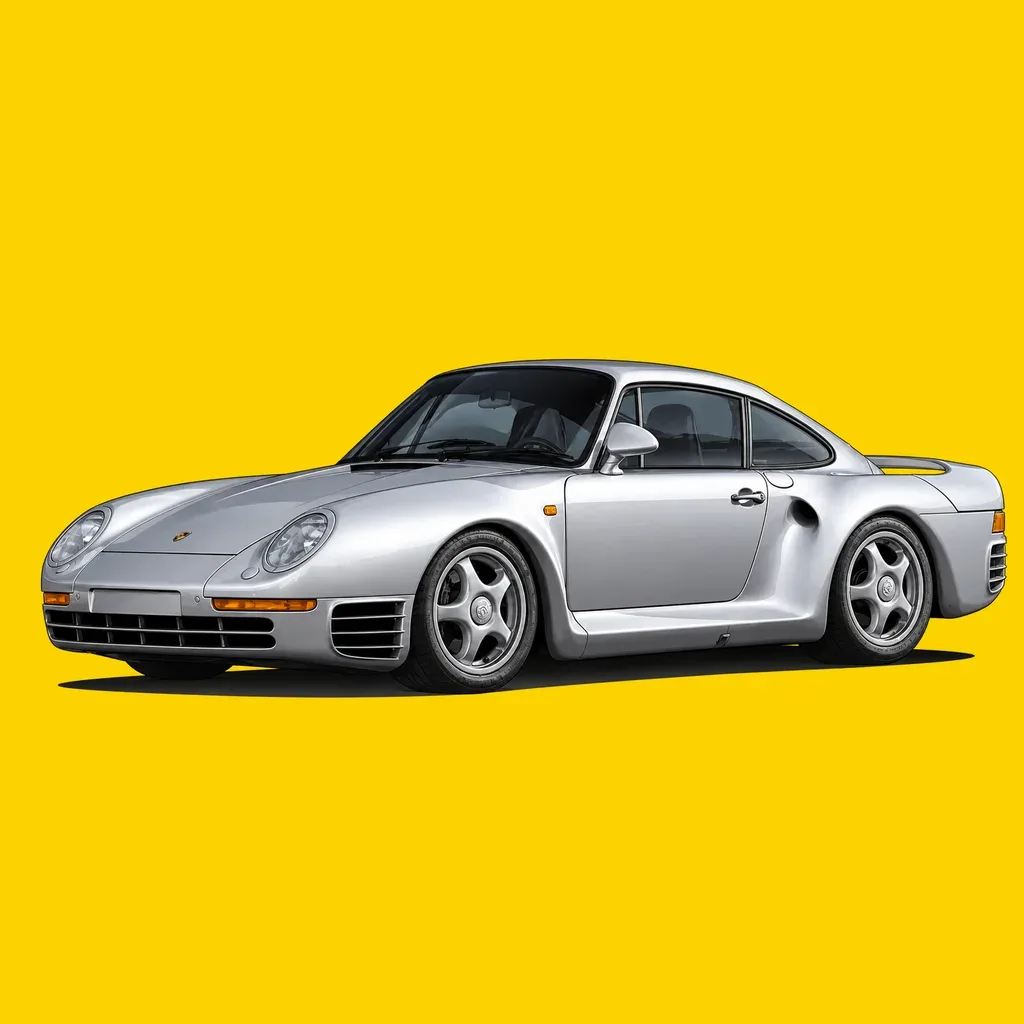
The 959 (1986) stands as the clearest single-model demonstration of Porsche's engineering ambition applied to a road car rather than a racer: sequential twin-turbocharging, a sophisticated computer-managed all-wheel-drive system, and run-flat tires with an onboard tire-pressure monitor were all genuinely novel for a road-legal production car at the time, pre-dating by years the technology that would eventually become industry-standard on performance cars generally.
The Carrera GT (2003) and 918 Spyder (2013) continued this pattern into the 21st century, the former a naturally aspirated V10 halo car built partly from Porsche's abandoned Formula One and Le Mans prototype engine programmes, the latter a plug-in hybrid hypercar that folded racing-derived energy-recovery technology into a road car years before hybrid hypercars became a recognized category.
Key People
Who shaped it?
Porsche's leadership history reads less like a corporate succession and more like a single engineering family working through three overlapping projects: the father's aviation-scale ambitions, the son's decision to finally build a car of his own, and the grandson's motorsport-then-industrial career. Few manufacturers can trace their engineering DNA this directly across three generations of one family.
Ferry Porsche in particular deserves credit not just as heir but as founder in his own right: it was his decision, against the consultancy model his father had built the company on, to put the Porsche name on a car at all.
↓ Read deeper↑ Less
Ferdinand Porsche's career before founding his own firm already included stints as chief engineer at Austro-Daimler and Daimler-Benz, where he developed a reputation for uncompromising, sometimes commercially reckless engineering ambition, a trait his own consultancy would inherit. His arrest by French occupying authorities after the war (over his wartime work) delayed the company's postwar restart and left Ferry to manage the crucial early years largely alone.
Ferry Porsche ran the company for over four decades, overseeing its transition from cottage workshop to a globally respected marque, and personally insisted on the 911's continued rear-engine layout even as engineers debated moving to a mid-engine configuration in the 1970s, a decision now regarded as one of the most consequential in the company's history.
Ferdinand Piëch's tenure at Porsche was comparatively brief but pivotal: as head of the racing and technical development department in the 1960s, he pushed the 917 programme to Le Mans victory in 1970 and 1971 before family politics (an agreement to remove Porsche and Piëch family members from operational roles) sent him to Audi, and eventually to the chairmanship of the entire Volkswagen Group, the same group that would later acquire Porsche itself.
Claim: the rear-engine 911 is a fundamentally unsafe, unpredictable car prone to sudden spin-outs. Truth: early 911s (pre-1990s generations, particularly with less sophisticated suspension geometry) genuinely could exhibit sudden lift-off oversteer if a driver lifted off the throttle abruptly mid-corner, the physics of a rear-heavy weight distribution are real and were a genuine handling challenge in period. However, decades of suspension refinement, and later electronic stability control, have substantially tamed this characteristic in modern generations; the "widowmaker" reputation reflects an earlier era of the car more than the current one. attributed
Claim: Porsche has "always" been an independent, family-controlled sports-car specialist with no corporate ownership entanglements. Truth: the company's ownership history is considerably more layered, Volkswagen Group now owns Porsche outright (following the reversed 2008–09 takeover attempt), and Porsche AG only became its own separately listed public company again via a 2022 IPO, within that larger ownership structure. verified
model-catalogue
What are its defining models?
Editorial inference
Porsche's catalogue is unusual for how much of its historical weight sits inside a single, continuously numbered lineage, the 911, rather than being spread across many distinct nameplates. Even so, the company's competition programmes and periodic halo cars have produced a genuine roster of standalone legends alongside the 911, and the 2000s brought real diversification into SUVs and sedans that now account for the majority of the brand's sales.
The list below favours genuinely distinct, historically significant nameplates and 911 generations over every individual model-year trim, a full accounting of 911 variants alone would run into the hundreds.
timeline-evolution
How did it evolve?
Editorial inference
Porsche's timeline divides naturally into distinct eras: the consultancy decades before any car bore the family name (1931–1948), the air-cooled sports-car era built around the 356 and then the 911 (1948–1998), the water-cooled modern era that began with the 996 generation, and the post-2009 period of increasingly close integration with the Volkswagen Group, culminating in Porsche's own 2022 stock market listing as a distinct, publicly traded entity within that group.
Each transition was contested internally at the time it happened, moving to water cooling in 1998 was treated by much of the enthusiast base as an existential threat to the brand's identity, and each was, in retrospect, absorbed without breaking the continuity the brand has always prized.
pop-culture-sightings
What does it mean in culture?
Editorial inference
Few cars carry as much instantly-readable cultural weight as the Porsche 911, a shape that has remained recognizable across six decades means it functions in film and television almost like a genre signal in itself: a 911 on screen frequently signals wealth, obsessive precision, or an enthusiast character without a single line of dialogue needed. Steve McQueen's 1971 film "Le Mans," built around Porsche's own 917 racing programme, remains the clearest example of the brand's motorsport identity being treated as cinematic subject matter rather than product placement.
The 959 and Carrera GT, as rarer halo cars, occupy a different cultural register, appearing in video games (particularly racing-simulation titles like the Gran Turismo and Forza series) more often than film, where their extreme rarity and technical reputation carry weight among enthusiast audiences specifically.
legacy
What did it leave behind?
Editorial inference
Porsche's legacy is less about any single technological breakthrough than about demonstrating an entire alternative philosophy for how a manufacturer can build long-term brand value: through continuity, iterative engineering discipline, and treating motorsport as genuine research rather than marketing theater. The 911's uninterrupted, recognizable evolution across six decades stands as the industry's clearest proof-of-concept for that approach.
The company's Le Mans record, more overall wins than any other manufacturer, and its willingness to commit real engineering resources to solving the rear-engine layout's inherent challenges rather than abandoning it for something easier, together form a case study now studied well beyond the automotive world in discussions of long-term product strategy and brand discipline.
rivals-comparisons
What did it compete against?
Editorial inference
Porsche's rivalries are unusually layered: on the racetrack, Ferrari has been the recurring measuring stick since the 1960s, particularly in endurance racing where both marques' engineering philosophies (Porsche's methodical, iterative approach versus Ferrari's more romantic, racing-first identity) have been directly compared for six decades. On the road, Mercedes-Benz and BMW represent the closest German rivals in the broader performance/luxury conversation, though Porsche has generally positioned itself as more purely sports-car-focused than either.
Perhaps Porsche's most persistent rival, though, is its own history: every new 911 generation is measured publicly and internally against its predecessors' reputation, a self-imposed competitive pressure few other manufacturers apply to their own back catalogue this intensely.
Sources & Confidence
Claims in this profile draw on categories of source material appropriate to their confidence level: company-published corporate history and press materials for founding dates and corporate structure; period motorsport results (Le Mans official records) for competition claims; and established automotive-history texts and period road tests for design and engineering narrative. Specific figures (production numbers, individual race results) should be cross-checked against Porsche's own archive and official Le Mans results where precision matters.
Questions readers ask
When was Porsche founded?
Ferdinand Porsche founded the company as an engineering consultancy in Stuttgart in 1931; the first car sold under the Porsche name, the 356, arrived in 1948.
Why is the 911's engine in the back?
The layout descends from Ferdinand Porsche's earlier work on the Volkswagen Beetle; Porsche has spent six decades refining the layout's handling rather than abandoning it for an easier front- or mid-engine design.
How many times has Porsche won Le Mans overall?
Porsche holds more overall Le Mans victories than any other manufacturer, spanning the 917, 956/962, and 919 Hybrid eras across five decades.
Does Volkswagen own Porsche?
Yes. Following a reversed 2008–09 takeover attempt (Porsche's holding company tried to acquire the much larger Volkswagen and failed), Volkswagen Group ended up acquiring Porsche instead; Porsche AG became its own separately listed public company again via a 2022 IPO, within the VW Group structure.
When did Porsche stop making air-cooled engines?
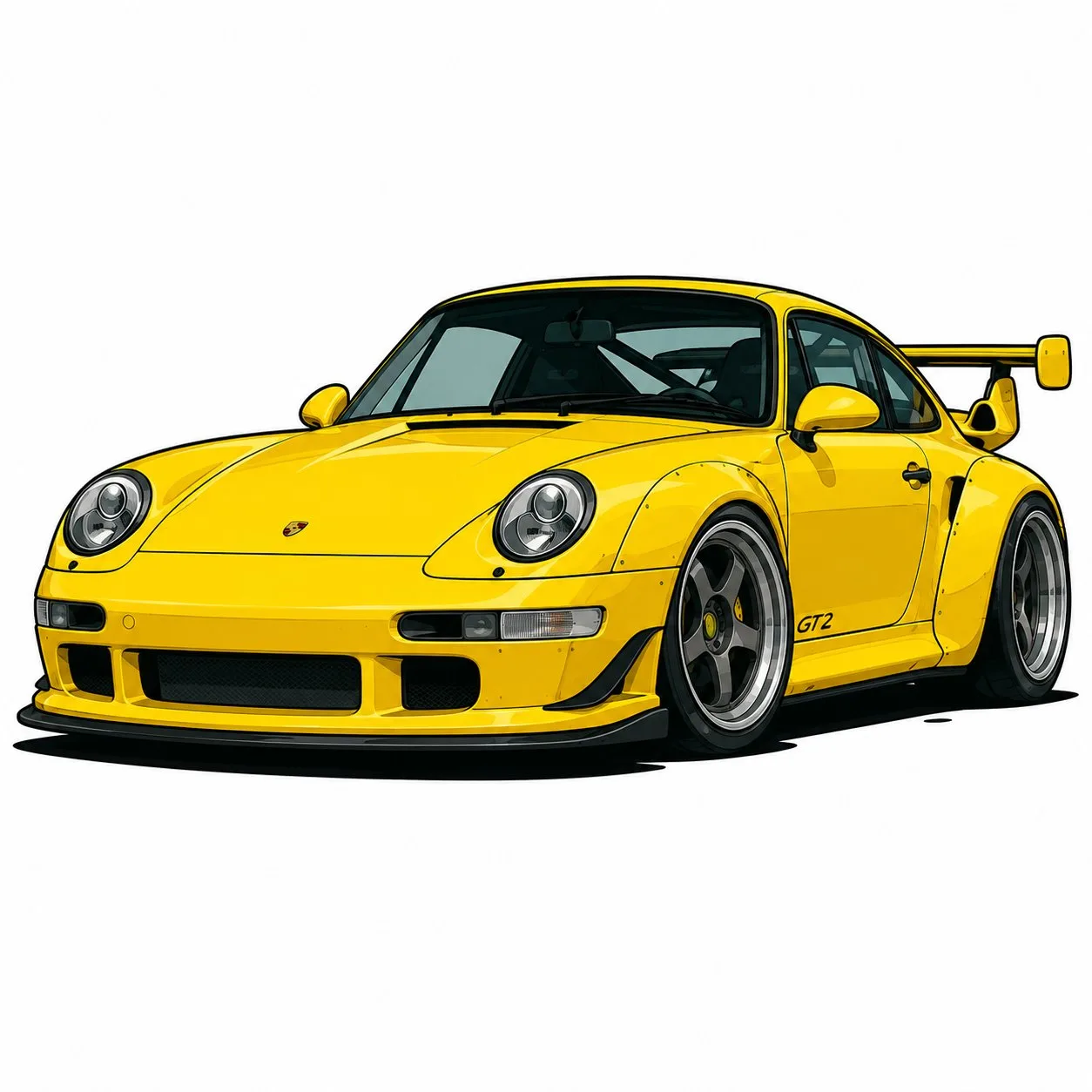
The 993 generation (1993–1998) was the last air-cooled 911; the following 996 generation, launched in 1998, introduced water cooling.
What was the Porsche 959?
A 1986 road car featuring twin-turbocharging and a sophisticated computer-managed all-wheel-drive system, years ahead of comparable technology on rival road cars.
Porsche: German Sports Car Manufacturer | Engine Sphere