
Article
The Last Analog Argument
Four machines that refused to separate driver from road.
June 2, 2026
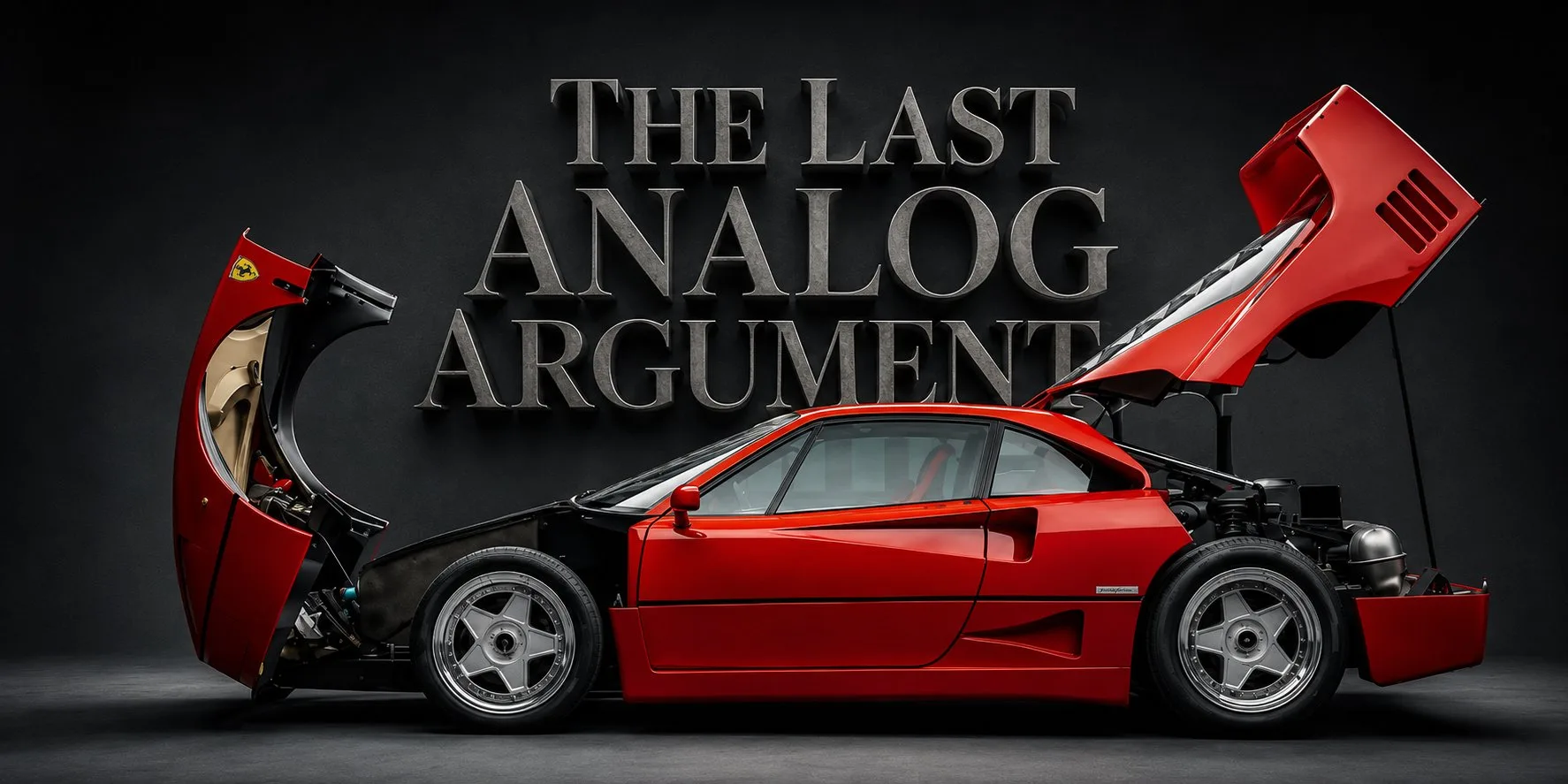
Before assistance systems mediated between hand and machine, four cars from four countries made the same argument in four different accents. Each still makes it today.
There is a narrow window in the history of the road car, the years after electronic driver aids became possible but before they came to define the way very fast cars behaved, when a handful of manufacturers still treated the driver as the primary control system. The Ferrari F40, the McLaren F1, the Porsche 911 GT2 of 1995, and the Pagani Zonda F belong to different points within that transition. Four machines, three countries, eighteen years, and the same underlying question: how much responsibility should remain with the person behind the wheel?
The analogue car was never defined simply by the complete absence of electronics. It was defined by what those electronics were allowed to decide. A manual gearbox, a clutch operated by the driver's left foot, an engine whose delivery had to be managed rather than requested, and a chassis whose character was not continuously rewritten by software. The F40 and F1 sit close to one extreme of that idea. The GT2 and Zonda F show what happened as selective assistance began to coexist with it. These four cars are not a purity contest. They are four points along the same retreat.
The Ferrari F40 opened the window in 1987, and it did so as a deliberate statement rather than an accident of engineering conservatism. Enzo Ferrari commissioned it to mark the company's fortieth anniversary, and it became close to his last public word on what a road-going Ferrari could be once comfort and marketing caution were removed. Ferrari test driver Dario Benuzzi described the car plainly: no power steering, no power brakes, no electronic devices of any kind. What remained was a tubular chassis, composite bodywork, a twin-turbocharged 2.9 litre V8 producing around 478 PS, and a gated five-speed manual gearbox. The F40 does not flatter indifference. It expects the driver to understand boost, weight transfer and consequence, and it offers no correction if that understanding arrives late.
Five years later, Gordon Murray carried the argument further. Murray had spent nearly two decades designing grand prix cars for Brabham and McLaren, and the road car he shaped in 1992 brought much of that discipline with it. Its 6.1 litre naturally aspirated BMW V12 sent 618 hp through a six-speed manual gearbox to the rear wheels, within a carbon-fibre monocoque unprecedented in a production road car. The F1 had no power steering, no anti-lock brakes and no traction or stability control. Murray seated the driver alone at the centre of the cabin, with two passengers set back on either side, so that even the driving position reinforced the idea of direct control. If the F40 opened the argument, the F1 may be its clearest expression.
Three years later, Porsche approached the same question from a different direction. The 911 GT2 of 1995 existed because motorsport regulations for the GT2 racing class prohibited all-wheel drive, requiring Porsche to create a rear-wheel-drive derivative of the 993 Turbo for homologation. Porsche removed the driven front axle, cut substantial weight and retained the 3.6 litre air-cooled twin-turbo flat six, with output raised to 430 PS. Unlike the F40 and F1, the road-going GT2 was not entirely without assistance, but its character remained rooted in mechanical consequence. Rear-wheel drive, turbocharged power, a manual gearbox and considerably less mass transformed the already rapid Turbo into something that demanded greater judgement from its driver. It remains the only air-cooled 911 to wear the GT2 name.
By the time the Pagani Zonda F arrived in 2005, much of the supercar world had already begun its migration toward automated and semi-automated gearboxes, traction systems and increasingly sophisticated electronic control. The Zonda F kept a genuine six-speed manual gearbox, driving a naturally aspirated 7.3 litre Mercedes-AMG V12 through the rear wheels. Named for Juan Manuel Fangio, Pagani's friend and mentor, it paired that mechanical architecture with ABS, traction control, power-assisted steering, a carbon-fibre monocoque and double wishbone suspension at all four corners. Its importance to this argument lies precisely there. The analogue experience had not disappeared when electronic assistance arrived. For a time, the two could still coexist without software becoming the principal interpreter between driver and machine.
Read in order, the four cars trace less a bloodline than four positions within the same transition: Maranello in 1987, Woking in 1992, Zuffenhausen in 1995, San Cesario sul Panaro in 2005. The F40 strips assistance away. The F1 turns direct control into an engineering doctrine. The GT2 retains mechanical severity while accepting selective assistance. The Zonda F proves that a manual, naturally aspirated, rear-driven supercar could still feel fundamentally analogue even after electronic safety systems had entered the equation.
That window did not stay open. Electronic stability control and increasingly sophisticated driver aids arrived not as a betrayal of performance but as genuine advances in safety, consistency and accessibility. The Last Analog Argument is not a case against what followed. It is a record of a period in which manufacturers were still deciding which responsibilities belonged to the machine and which belonged to the driver. The Ferrari F40, McLaren F1, Porsche 911 GT2 and Pagani Zonda F answer that question differently, which is precisely why they belong together. Their full dossiers are catalogued on Engine Sphere, sourced, dated and connected to the people who built them.
Also in the Gazette
The Last Analog Argument
Related Topics